Skip navigation

Tag Archives: review

Sir Lancelot:
We were in the nick of time. You were in great peril.

Sir Galahad:
I don’t think I was.

Sir Lancelot:
Yes, you were. You were in terrible peril.

Sir Galahad:
Look, let me go back in there and face the peril.

Sir Lancelot:
No, it’s too perilous.

Sir Galahad:
Look, it’s my duty as a knight to sample as much peril as I can.

Sir Lancelot:
No, we’ve got to find the Holy Grail. Come on.

Sir Galahad:
Oh, let me have just a little bit of peril?

Sir Lancelot:
No. It’s unhealthy.

Sir Galahad:
I bet you’re gay.

Sir Lancelot:
No, I’m not.”

Reader, he absolutely was. But that’s beside the point.

Okay. So. Monty Python and the Holy Grail is not my only experience with Arthurian legend, but it makes for a fun starting point when diving in to Thomas D. Lee’s Perilous Times, which came out this Tuesday. A long time ago, after the death of their king, the Knights of the Round Table made a deal with Merlin to be resurrected any time the realm (that is England) finds itself in great peril. Over the centuries, Sir Kay, Lancelot, and the rest have come back to defend England from whatever threats may have arisen. This time, though, it’s something none of them could have foreseen (except Merlin, of course). When Kay, Arthur’s brother, awakens beneath his tree and pushes his way to the surface, he finds a fracking facility nearby. Upon investigation, he meets a young climate activist named Mariam who is in the process of planting a bomb at the facility. After rescuing her from the private security firm guarding the site, he accompanies her back to the camp where he meets the rest of her group. There, they explain to Kay just how dire the Earth’s situation is. Climate change has flooded almost half of England, and there are no signs of it slowing or stopping on its own. So, Kay has found his peril. But how do you fight climate change with a sword and shield?

Meanwhile, elsewhere in England, Sir Lancelot has awoken as well. He’s accustomed to coming back for wetwork and other clandestine purposes, and his handler Marlowe (yes, that Marlowe, having achieved a sort of immortality by his own means) has a new target for him. Someone he knows who has recently gotten on the wrong side of Marlowe’s bosses. Someone he’s known for a very long time: Kay. The realm is in grave danger, and it may be time to bring about the prophecy of Arthur’s return…

Thomas D. Lee’s love for Arthurian legend shines through every bit of Perilous Times, as Kay learns more about the current state of the world and what new evils are caught up in it. Mariam and her friends are a sympathetic and diverse crew of women bent on saving Earth, but they don’t stand a chance against dark magic without Kay’s help. Cam he explain himself to Lancelot before finding himself dying yet again?

My utmost thanks to NetGalley for an eARC of Perilous Times in exchange for a fair review. It’s out in the world as of Tuesday, May 23rd. Do yourself a favor and check it out.
Anequs is a young Indigenous woman born and raised on the island of Masquapaug, far from the colonizing influence of the Anglish people. After spotting a Nampeshiwe, one of the dragons once common in the area, she quickly goes home to tell her family what she has seen. Uncertain if it was really there or just a vision, she ventures back out the following day and finds not the adult dragon, but a Nampeshiwe egg—the first one seen in generations.

When the baby Nampeshiwe hatches in front of the entire community of Masquapaug, she chooses Anequs to be her bonded partner. Anequs names her Kasaqua and becomes the first Nampeshiweisit (dragon partner) in the memory of anyone on the island. Now Anequs would’ve been perfectly content to stay in her family home and raise the dragon there until Kasaqua, in a moment of fear and pain, releases her breath weapon. Seeing the raw destructive power even a baby dragon possesses convinces Anequs to follow her older brother’s advice and apply for Kuiper Academy, the Anglish dragoneer school in the distant city of Vastergot.

Soon, Anequs is off to another world, one where the white men control everything from how history is taught to who gets to be paired with a dragon. The school accepts her application, but the threat of death for Kasaqua if she can’t learn to be tamed to their standards looms over everything.

Anequs doesn’t fit in at the school, since she wasn’t raised in Anglish society. She doesn’t know the rules that she’s supposed to follow, and so she rapidly befriends the other “misfits” of sorts, including an autistic student (in one of the most accurate and sympathetic portrayals I’ve ever encountered in literature), the one other Indigenous dragoneer, and one of the laundry maids. She spurns the use of the assigned surname Aponakwesdottir, insisting that the only name that she needs is Anequs. She can read and write, which is more than many of the white students and professors expect of her. In short, neither Anequs nor Kasaqua are what the students and staff and Kuiper anticipated. Nor is the school what Anequs had hoped for, with the narratives and views of white men dominating every aspect of the society. Now she must navigate adolescence, dragon-rearing, school, and an openly hostile culture that would prefer her not to exist.

To Shape a Dragon’s Breath is brilliant. The world is simultaneously strange and familiar, set on an Earth in the early industrial age with technological innovations driven by dragons, who can break matter down into component elements with their breath. The breadth and depth of the worldbuilding is staggering, with tremendous care put into the little details. The scientific processes are as thoroughly explored as any contemporary fantasy’s magic system, with almost every aspect having a real-life counterpart. I loved following Anequs as she learned about the world beyond the boundaries of her island, and I can’t wait to come back to the world of the Nampeshiweisit.

Moniquill Blackgoose’s To Shape a Dragon’s Breath is out in the wild today. Go catch yourself a copy.

My utmost thanks to Random House/Ballantine and NetGalley for providing me with an eARC of the book in exchange for an honest review.

When Aelis arrives in Lone Pine, she’s struck almost immediately by the smell of sheep shit. This doesn’t bode well for her scheduled two-year tenure as the new Warden of the small farming village out on the border with orc country. Still, she has no way to contest her station, despite her wealthy heritage. The Lyceum where she studied wizardry saw fit to send her to Lone Pine, even if it doesn’t seem like a proper location for a Warden who specialized in Necromancy.

Truth be told, Aelis would rather be anywhere else. Any urban post. Somewhere closer to her friends and lovers from school. Anywhere were her contractually obligated housing isn’t a broken down, falling apart tower. Anywhere she might have people to protect who aren’t deathly afraid of her. But no. She’s in Lone Pine, and only Martin and Rus, the local innkeepers, have any tolerance for her presence. Almost everyone else shuns her and attempts to avoid her at all costs. It’s a rough start, to be sure, but it’s Aelis’s station, and she’ll do her job. She’s a Warden, after all, not just a wizard.

When a group of adventurers make their way into Lone Pine from a frontier excursion, cart laden with gold to spend in the small town, it seems like the fortunes of the villagers are about to change. However, a violent encounter shatters the peace and sends Aelis on a quest to track down the guilty party. Her journey will take her into the wilderness, and bring her face to face with threats both old and new.

Daniel M. Ford’s The Warden is out in stores today, and I highly recommend it to any D&D player or fantasy adventure fan, especially for those who’ve enjoyed Travis Baldree’s Legends and Lattes or Tamsyn Muir’s Gideon the Ninth. It was an absolute treat to read, playing with tropes and expectations throughout the book. I’ve loved every minute that I’ve spent in this world, and I hope to get to visit it again soon.

My utmost thanks to NetGalley and Tor Publishing Group for access to an eARC in exchange for an honest review.

J.S. Dewes’ latest science fiction novel, Rubicon, opens with a bang as our protagonist is forced to kill her three squad mates and then herself. Specialist Adriene Valero wakes up almost immediately afterward, her consciousness having been automatically downloaded into a new body back at headquarters.

Rezoning, as the process is called, has been standard procedure for soldiers fighting on the front lines against the Mechan forces. It allows humanity to avoid being captured and utilized as a host for a Mechan unit, a process called hybridization. If you’re under imminent threat of capture, zone out. Better to die by your own hand (or a fellow soldier’s) than to play host to an alien robot consciousness until your body gives out.

After rezoning into her 96th “husk” since the beginning of her service, Adriene is ready for it to all end. Anything for a chance to be mortal again. But instead of being sent back to the front lines with the rest of her squad, she’s pulled out of her company, promoted, and shipped off to a new unit. She’s been deemed a good fit for an elite crew of soldiers outfitted with special Virtual Intelligence implants called Rubicons, and assigned to be the pathfinder of one of their advance recon squads.

After a quick training on the use of the Rubicon implant in her brain, Adriene has to adjust to the idea of someone else sharing her head, privy to her thoughts whenever the unit is active. On the squad’s first mission out together, they’re ambushed by Mechan drones. With yet another rezone on the line, Adriene taps into an unknown function of her Rubicon implant, accessing functions that shouldn’t be possible.

With the knowledge that her Rubicon implant may be unique, Adriene is soon forced to face a choice. On the line: her chance to finally end her rezone cycle and the fate of all that remains of humanity under the unsleeping eye of the Mechans. Then again, Adriene may have more in common with the Mechans than anyone has ever realized.

Rubicon is a phenomenal piece of military science fiction that’s perfect for fans of Halo, Starship Troopers (Robert Heinlein), Old Man’s War (John Scalzi), The Light Brigade (Kameron Hurley), or Edge of Tomorrow. It’s out on shelves today, and you should most definitely check it out. Dewes has done a great job of hooking me with her writing, and I’m eager for more.

My utmost thanks to NetGalley and Tor Books for providing an eARC in exchange for a fair review.

Some family secrets are supposed to stay buried.

Sam’s having a rough time. Her post-graduate fieldwork in archaeological entomology is on hold, and so she makes the long trans-Texas drive from Arizona back to North Carolina to live with her mother until the work has funding again. Sam’s mother is living in her own mother’s old house now that Gran Mae is dead, and is happy to have Sam come back home for however long it will last.

The problem is that the house no longer feels like home for Sam. With blandly-painted walls (ugh, ecru), and familiar knickknacks out of sight, the house itself seems to be telling her that something is wrong. Never mind her mom’s behavioral regressions to the days of Gran Mae’s life, or the vultures that are hanging out in the neighborhood. There’s also Gran Mae’s rose garden, which, while stunningly beautiful as ever, is suspiciously devoid of insect life (trust Sam on this one, she’s an entomologist, after all).

Before long, Sam begins to have dreams of her grandmother, and remembers things she said. “The roses say to say your prayers,” and “the underground children will get you…” and not-so-startling fatphobia linger in her memory. But how much of that was real? All is clearly not well on Lammergeier Lane, and Sam is determined to find the answers. Negotiating Southern hospitality and prejudices and overcoming her own fears will be critical.

A House With Good Bones is a quick, fun horror read, y’all. T. Kingfisher has put together one fantastic ride. I loved following Sam on her journey through her family’s past as she strove to save her mom and herself from a disturbing legacy. Not to mention that I will never look at ladybugs (Coccinellidae) the same way again.

My utmost thanks to NetGalley and to the folks at MacMillan/Tor for an eARC of A House With Good Bones in exchange for a fair review. You can snag a copy for yourself starting on March 28th.

I’ve followed Sim Kern on Twitter for a while, and so when they put an open call out for ARCs of Seeds for the Swarm last year, I jumped at the chance. What a perfect companion piece to Annalee Newitz’s The Terraformers. Climate change fiction (or cli-fi), is a hot topic, and Sim handles it marvelously.

Sassparylla “Rylla” McCracken lives in The Dust, a dried-out portion of the United States devastated by manmade climate disasters. Specifically, Rylla and her mom live in a trailer house in Texas, near what remains of the Guadalupe River outside of Austin. Rylla is a high school senior, attending virtual classes and spending her free time studying the insects and other wildlife that are managing to survive in the harsh, dry climate. When she learns that a new piece of corporate legislation is aiming to dam up what’s left of the river, Rylla begs her brother Tyler for a ride to the state capitol, where she delivers an impassioned speech to the apathetic legislature.

Thanks to a video edit of her speech at the capitol going viral, Rylla is approached by representatives from Wingates University, a school located deep in the Lush States where water and other resources are still abundant. Before she knows it, Rylla is whisked away to Michigan, where she is quickly overwhelmed by how different of a world her classmates come from. Rylla is placed in the Humanities department at Wingates, where she is tasked with studying the behaviors that lead to the current state of the world. She also befriends a group of engineering students working on different types of new technologies that they believe can save the planet and the human race.

After a trip through the campus transport system goes wrong, the existence of a secret series of laboratories deep beneath Wingates is uncovered. Soon, Rylla and her classmates finds themselves caught up in a conspiracy of nanotechnology, bioengineering, and political intrigue that could very readily lead to a new civil war, with Rylla’s mother and brother stranded in The Dust. As if just going to college and juggling a social life and homework wasn’t stressful enough…

Seeds for the Swarm is a brilliant piece of climate-focused science fiction, taking an unflinching look at what our world could look like in a few short decades. Rylla is a delightfully and frustratingly human protagonist, reminding me of many of my own college friends (though we didn’t have world-ending tech at our fingertips). Her struggles to fit in among her fellows at school are fantastically well-rendered and realistic. Kern’s vision of the near-future manages to still stay hopeful, even in the face of overwhelming odds.

Seeds for the Swarm is available from Stelliform Books on Wednesday, March 1st. Get it from your library or bookstore of choice, and enjoy.

My utmost thanks to Sim and to Ren Hutchings at Stelliform Books for an eARC in exchange for a fair review.

Dear readers, I have done myself a disservice by not reading Annalee Newitz’s work before now. I had picked up a copy of Autonomous from my library back in 2017, but I never managed to get around to it. Now, I know that I have to come back. Newitz is a phenomenal world builder, and in their latest book, The Terraformers, they do it literally.

The Terraformers tells the story of Destry, a sort of forest ranger of the future. Destry lives on the planet Sask-E (or Sasky, as most of the locals have taken to blending the name), and along with her partner, a moose named Whistle, she has spent centuries carefully guiding the ecosystems into an Earth-like state. Destry and Whistle are members of the Environmental Rescue Team, or ERT, and on Sasky, they work under the corporate authority of Verdance, a real-estate company that deals in planets.

Destry and Whistle are used to working on a slow scale, shaping a world in a way that maintains its harmony. Neither of them is expecting the sudden shift in Sasky politics when a city full of older ERT rangers is found, hidden away from Verdance’s knowledge. Soon, the two are caught up in a storm of corporate ideology, civil rights, and what it means to be a person on a planet that’s isolated from the rest of the universe. After all, terraforming is long series of violent actions, forcing a world into the condition you desire. The tools that are used can be deadly in the wrong hands.

The Terraformers is a deep dive into politics and relationships the likes of which I haven’t read since Ursula K. LeGuin’s The Left Hand of Darkness. It’s the story of a planet that spans centuries and generations. It’s dense, queer, sad, and beautiful. My utmost thanks to the folks over at NetGalley and Macmillan-Tor/Forge for providing me with an eARC in exchange for a fair review. It’s out today. Go check it out.

The Beyond is ever-shifting, a fluctuating space of deadly light and impassible dark, filled with dangerous creatures. An adventuring party must consist of six members in order to venture across the Beyond. One Gate (to open the way and find the paths in the shifting wilderness), one Ghost (who becomes a silent, intangible scout once in the Beyond), one Shotgun (the party’s primary combatant), one Voice (the polyglot communications specialist), one Lantern (to light the way), and one Keeper (who remains behind at the group’s Keep, maintaining a stable entry platform that bridges the Beyond and the solid reality of the Realms. These six members make a Hex. Why six? Something about the magic that the dragons use to travel through the Beyond on their own can only be replicated by a group of six. Too many more than that, and the Beyond can destabilize even further. Too few, and you can’t be protected from the various monsters that call that nightmare place home.

Esther is a Lantern, but she’s semi-retired. Her Hex was suspended from operating a year ago, leaving the rest of her closest friends out of work. One night, a mysterious phone call wakes Esther, a single word from David, her son and the Keeper of the Hex. Immediately, she springs into action to gather the other members of the Hex and rally at the Keep to gather information. David, it seems, has been kidnapped, leaving his spouse Kai and their children behind in the unguarded Keep. Someone has captured him, and Esther must journey across the Beyond to find the party responsible. While Marianne, Gus, Lydia, and Faye all answer Esther’s summons, not all of the Hex is happy to see her again, especially since their suspension means that they’re not technically supposed to be operating in the Beyond at all.

So begins a covert mission to find David and bring him safely home. After all, what wouldn’t a parent do to protect their child?

Kate Elliott has crafted a phenomenal sci-fi novella with group mechanics reminiscent of a Dungeons and Dragons party. I’m fascinated by both the Beyond and the many Realms that it links, and I’m honestly sorry that this is my first time tackling one of her stories. I hope that she revisits this world again soon.

The Keeper’s Six is out today. I hope you enjoy it as much as I did.

My utmost thanks to Tordotcom for providing an eARC of this novella in exchange for a fair review.

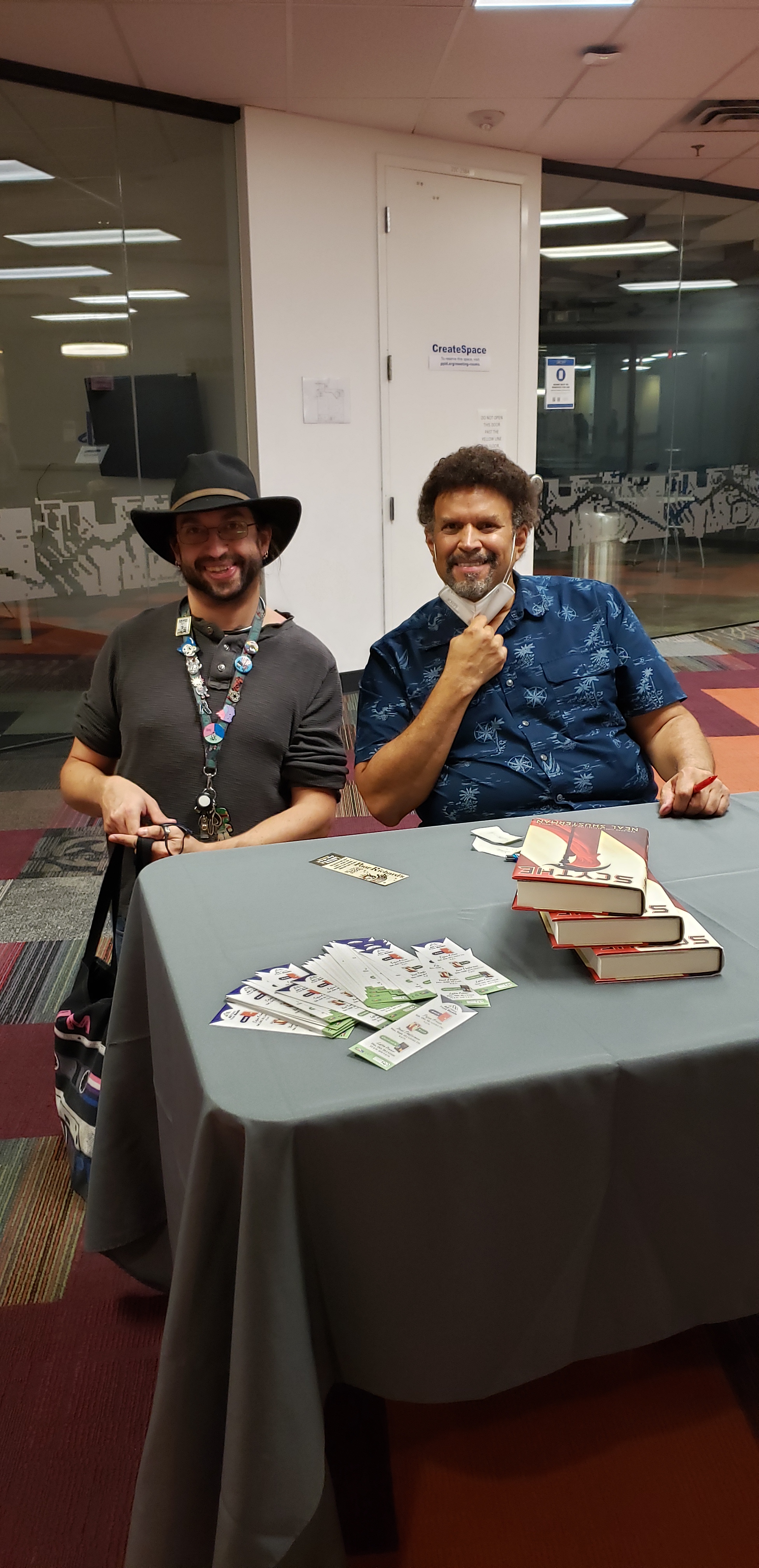
It’s no secret that I love Neal Shusterman’s Arc of a Scythe series. I’ve reviewed his books before, and I even had the honor of meeting him in person earlier this fall.

Photo of me (left) with Neal Shusterman (right) at a local book signing.

Now I was surprised partway through Thunderhead when I learned that the series wasn’t a duology, but in fact had a third book announced just a few days prior. I was even more excited when I found out that he was returning to the setting with a new collection of short stories. Gleanings hit store shelves yesterday, and folks, it is fantastic.

It feels so good to be back in this dystopia. Shusterman’s worldbuilding is second to none, and even through brief snippets of poetry and prose, it all came rushing back. A planet full of immortals, a small order of people who can render others permanently dead (and in fact are required to do so), and an artificial intelligence that oversees everything but doesn’t interfere with the business of Scythes: all of these components are now familiar. This anthology presents a wide array of new stories, from Scythe Curie’s first conclave after her apprenticeship and her earning of her legendary title to a Halloween party that echoes Edgar Allan Poe’s The Masque of the Red Death. Shusterman and his various co-authors are bringing even more depth to an already expansive world. I can’t thank NetGalley and Simon & Schuster enough for an eARC in exchange for a fair review. Gleanings is out on shelves as of yesterday. Enjoy!

Last July, fans of Tamsyn Muir’s delightful Locked Tomb books were informed that they wouldn’t be getting Alecto the Ninth in the fall of 2021 as they had previously expected. Instead, the Locked Tomb trilogy was going to be expanded into four books, with Alecto still set as the final entry, and Nona the Ninth filling in a gap in 2022.

So we waited, albeit not particularly patiently, for an extra year and a half. Three days ago, that wait came to an end, and last night I finished my preliminary time with Nona. Y’all.

Let’s get one thing out of the way first, okay? This is the 3rd book in a series, and as such, some spoilers for books one and two (Gideon the Ninth and Harrow the Ninth, respectively) are unavoidable. You have been warned.

SPOILERS FOR GIDEON THE NINTH AND HARROW THE NINTH MAY FOLLOW BELOW:


.

.

.

.

.

.

.

.

.

.

Okay. Ready? Here we go.

Nona is an unexpected character, headlining an unexpected, but long-awaited book. The book opens a few months after the end of Harrow the Ninth and the destruction of the Mithraeum. John “God” Gaius has vanished following His betrayal by two of His Lyctors. Gideon the First has been lost to a Resurrection Beast, and his cavalier, Pyrrha Dve is now the sole inhabitant of his body. Camilla Hect has been trading time in control of her body, swapping with the soul of her necromancer, Palamades Sextus (last seen possessing his own skull, which was transformed into a hand by Harrow in Book 2). Together, Pyrrha, Camilla, and Palamades watch over Nona and try to avoid direct conflict with Blood of Eden, a group that stands in opposition to God and the Nine Houses. But who exactly is Nona?

On the outside, Nona is Harrowhark Nonagesimus, whose body was last seen alongside Pyrrha Dve as Augustine the First threw the entirety of the Mithraeum into the River in an attempt to kill God. But the River is full of lost souls, and something happened to the soul of Gideon Nav, who was piloting Harrow’s body. While Harrow’s own soul appeared to have made its way through the River to the Locked Tomb back in the Ninth House at the conclusion of Harrow the Ninth, her body didn’t go along for the ride. Now the body, Nona, has woken up on the world of New Rho. She and her guardians/teachers are busy trying to figure out just which soul (or souls) reside within her. Is she a necromancer? Is she a cavalier? Is she neither or both?

Right now, Nona is a girl looking forward to her first birthday party; a toddler’s attitude in a teen’s body, new to the world and learning quickly about how complicated her life actually is. She’s working as a teacher’s aide at her school, trying to make friends and to fit in with the students. She walks the science teacher’s six-legged dog, Noodle. She loves Noodle. She’s unbothered by the blue light in the sky that seems to be wreaking havoc on any necromancers who wander outside, and she heals almost instantly from any wound, but she shows no aptitude for any other necromancy. She practices with a sword, but has none of a cavalier’s familiarity with the weapon.

Meanwhile, Camilla, Palamades, and Pyrrha are trying to find the rest of the Sixth House, who fled from their former home in an attempt to evade God’s wrath and are now being held captive somewhere on New Rho. Blood of Eden is threatening to destroy a Cohort facility and kill the soldiers and necromancers of the Nine Houses who have taken shelter there. Tensions are rising, and time is running out. Solving the mystery of Nona’s identity is the key to everything, but no one is making it easy. Will God return to New Rho? Will the Resurrection Beast lurking nearby destroy the planet? What other characters will get cameo appearances this time around? Will Nona get to celebrate her first birthday? Is Noodle a good boy? So many questions, so little time.

Nona the Ninth is beautiful and heartbreaking. It’s a perfect addition to The Locked Tomb series. Tamsyn Muir continues to weave plotlines, juggle bodies and souls, and blend humor and horror in a way that boggles my mind. While the finale is still (hopefully only) a year away, Nona is a wonderful treat for readers. Plenty of twists and turns will keep everyone guessing right up until the end, and then the wild theories can begin again! I can’t wait for Alecto, but I’m so glad to have Nona to keep me company between now and then.

I’m going to go read it again.