Skip navigation

Tag Archives: writing

“Winter”

Today I look west over the mountains
And I see the sun sinking below them.
Snow coats them, and I dream briefly
Of distant oceans, islands, tropical
Paradises where the sun will not set for
Hours and the people have never had to
Wear clothes with long sleeves and the
Only skiing to be had is done behind a
Boat, and I remind myself of why I
Stay where I am, in a land that gives me
A proper winter.

When I was a child, my older sister invented a world in the garden. I’m not sure if it was more inspired by Narnia or Terabithia, because to me it seemed to be equal parts of both. It’s strange to think of a lush realm in the midst of the Colorado plains, but she managed it somehow. It was hidden away beneath the shade of a plum tree and walled in by a grape vine, and it was there that she established her domain. During the spring, she would pick flowers from the local greenhouse and plant them in her little corner of the back yard. It was a fantastic spot to spend a hot afternoon. With fresh fruit growing overhead (and around the corner in the main part of our parents’ garden) and water from the hose, you could stay out there for hours.

I never said anything to her then, but I was jealous. I wanted something like that, and she’d taken the best spot in the yard for it. I realize now, though, how important having a space of her own was to her. When we were kids, there were four of us sharing two bedrooms, and it was never easy for any of us to get time to ourselves. If I had the bottom bunk of the beds I shared with our youngest sister, I would hang blankets up to turn it into a fort. When we got a new fridge, I asked to keep the box it came in. Some scissor work and marker drawing later, it sat on the top bunk and turned into a Calvin and Hobbes-esque spaceship. Both of these spaces were mine, despite only being partitions within another room.

We would seek out places where our creativity could thrive. I didn’t realize how essential it was then, but the space we could make for ourselves was critical to us. Our imaginations were fueled by the books we read and heard, and the desire to craft something from our own thoughts moved us forward. Today, my big sister is an architect, and I couldn’t be more proud of her. She went to college and poured herself onto canvas and into sculpture, bringing her imagination into reality. Just like she did in the garden back home, she’s making the world a little more like she dreamed it could be, one small space at a time. It’s an incredible bit of inspiration for me. I may use a keyboard or a pen and paper where she used paint and clay (and now wood, concrete, steel), but I like to think that, at least in some small way, I’m following a part of her path.

I could see the dust clouds rising in the distance long before I heard the slow rise and fall of the sirens. On the plains, you can see forever. I ran back into my grandfather’s house and grabbed the binoculars from their place on the back of his dining room chair (where they would always be close by so that he could watch birds at the edges of his property or approaching storms rolling in over the nearby towns to the west). Looping the carrying strap over my shoulder, I dashed back outside and scrambled up the television antenna next to the house. Stepping across the gap to the green-shingled roof, I climbed to the apex and brought the binoculars up to my eyes.

There! They were still several miles away, but getting closer by the second. A quick adjustment of the focus knob brought the cars into sharper view. There were four of them; three were police cars with their lights flashing a staccato red and blue rhythm. Leading them all was one car that I can only describe as a cherry red Detroit dream, with outrageous fins and chrome surfaces catching the August sun and threatening to blind me. It had to have been customized. There was no way the stock engine would have given him the speed he had. The driver was pulling away from the cops, clearly outmatching them in both skill and machine. He was using them against each other on the narrow dirt roads, using his speed to thwart any of their attempts to outmaneuver him.

Closer now, and I adjusted the binoculars again until I could make out the writing on the police cruisers. Two were local, town cops having apparently joined a sheriff’s deputy in the chase. His car was superior to theirs, but the county roads were clearly not familiar to him either.

I knew them well. My dad had taught me to drive on that stretch of road. I knew full well where the neighboring farmers’ sprinklers caught the gravel beyond the edge of their fields, washing away some of the stable surface of the road or turning the low-lying stretches into very small swamps. I knew the intersections where the corn grew tall in the late summer, blocking a driver’s view of any oncoming traffic. I knew where the semis driving through had turned the road into a washboard until the next time the county could send a road grader through to smooth it out again. There were dead ends lurking where anyone not paying attention would find themselves flying off an embankment and into a ditch. Even if you spotted any of the hazards, there was no guarantee that hitting your brakes would keep you safe.

I knew that the cops didn’t drive out into the country unless they absolutely had to. An occasional domestic violence call when a wife had finally found the courage to seek help, a child who had wandered farther from home than usual, a controlled burn getting out of hand when the wind shifted suddenly; these sort of things, they were used to dealing with. A high-speed chase down narrow, unpaved roads? Not so much. Now they were coming up to the Ackers’ farm and I could finally hear the shifting pitch of the sirens. I felt my heart beating faster as the older car pulled farther ahead, adrenaline surging as I imagined myself in the driver’s seat, laughing out loud as I saw one of the city cops skid and spin a 180 into the ditch, hurting only his car and his pride. The other cop and the deputy managed to keep themselves on an even course, but the driver in the red car had gained nearly a half a mile.

The cars were close enough to see without the binoculars now, so I let them hang around my neck and watched anxiously as the red car swerved to the left at the edge of my grandfather’s tree line, dust flying as he stomped on his brake pedal in an impossible U-turn onto our property. The deputy and his cohort sped past, losing track of their prey in the cloud he’d kicked up. The driver, a long-haired man in a backwards baseball cap, was grinning like a madman as he wove past the John Deere outside of the shop, past the end of the paved driveway, and back out onto the road, back east toward Ackers’ again. Soon he was just a column of dust on the horizon. I raised the binoculars and watched him fade into the distance as the officers too late realized their mistake and changed direction, climbed back down the antenna and went inside. My grandparents were drinking coffee and watching Murder She Wrote with the blinds shut, and I doubted that they’d even noticed the events of the last few minutes, so I made a point of not mentioning it to them, sitting down with them and watching the rest of the show instead.

I had never seen the car before, and I never saw it again. Same for the laughing man behind the wheel. I checked the local newspaper the following Wednesday, but there was no mention of the chase in the city or sheriff’s reports. I like to think that whoever he was, wherever he was from, he’d wanted a little adventure for the day, and he somehow found a way to share it with me. To this day, I wonder what it must have felt like to have the thrill and uncertainty of that pursuit, not knowing if he’d be able to make the turns and courting death with every second. I’ll never forget the roar of the engine calling to me as I stared at the taillights, the smell of tires grinding into gravel. When I go back to the farm, I still climb up to the roof and watch for him, binoculars in hand, waiting to see that Detroit dream one more time.

This piece was written for Chuck Wendig’s latest Terrible Minds Writing Challenge. Thank you for reading. Don’t forget to check out the other entries!

“The river stole the gods.”

That’s what my grandmother used to say, anyway. “The river stole Them away from us, and left us alone. Left us to survive without Them.” They had belonged to our people for centuries, longer than we’d been maintaining a record of our tribe. I still remembered the stories that we would hear every night, that the elders of the village would share. Stories of how the gods came to be, what They did.

The First of the gods had come to us from the river, so it never seemed strange to me that the river had taken Them back. It was perfectly logical to me, but I was always a bit strange, according to my brother. The First was born to us from the reeds and the mud, given shape by the flowing water that still sustains our village. The sun looked down and saw the shape, and baked Him into hard clay, and the full moon looked down on the empty body and saw fit to give Him a soul, and then the moon began to wane, and He rose up and made His seven sisters and brothers in the same manner. Soon, all of the gods had been given Their shape, with the First asking the sun to dry Them, and the moon to give Them souls as well. The sun complied willingly, for the sun is always hot again with each new day, but the moon replied that there was but one soul left, and that it was the moon’s own soul, for there could be nothing more given until the moon was full again. So the First god took His own soul and broke it into eight pieces on a rock at midnight, when the moon was gone, for He could not wait for the moon to return with new souls. My grandmother told us that this was supposed to be a lesson about patience, but I never really understood why. I wanted to ask her if the rock the First had used to break His soul was still there, if she knew where He had done it. Instead, I’d just smile and nod and encourage my brother to do the same so that she wouldn’t yell at us for not learning from her stories. Father and Mother would have spanked us, so even the yelling was preferred if it came to that.

One fraction of the First’s soul, He took back into Himself. The remaining seven fragments were given to His brothers and sisters, and once They too possessed souls, They stood by His side. Together, They then set about naming all of the things, and dividing the world into parts that each of Them would oversee. The seas, the skies, the stars, the earth, the plants, the beasts, time. Each of the First’s siblings was god of these things. The First presided over Them all, giving Them guidance, since He was connected to all of Them through His soul. For centuries, our people lived in peace under Their rule, and They would return to our village every month to visit the place of Their birth. “We would watch Them from a great distance, and we could see that every one of Them stood at least twice as tall as my father, who was the tallest man in the village,” my grandmother said. “And we would hide, but still try to see what They were doing. Their gatherings always lasted from sunrise to moonrise, as They honored the place of Their birth. They appeared at dawn, They stood at the river’s edge in the mud from which They were formed, and They vanished as the moon took its place in the sky.” We asked my grandmother to describe Them, beyond Their great height. “They were the color of the river, bright when the sun shone on Them, blending with the night save for a subtle shimmer when it didn’t. They were beautiful.”

The gods were kind, benevolent, and very slow to anger. My grandmother only knew of one time when They had seen fit to punish any of the people of our village, just before the river took Them. It was harvest time, and one of the men of the village had been found having killed his neighbor. Murder was unheard of in the village. Death was not uncommon, but it was not the explicit realm of any of the gods, and so it was deemed to be something far beyond the control of men. After all, if the gods have no power over a thing, what hope does man have of controlling it? When this man was found with another’s blood on his hands, he was locked away until the next time the gods came. The villagers had no idea that it was going to be the last time. The gods returned as was Their fashion, and instead of hiding from them, my grandmother’s father stood near where he knew they would appear. When They arrived, he called out to them, and my grandmother and the others hid in the usual place. “My father spoke to them,” she says, “but we couldn’t hear him or Them from our hiding place. Eventually he came back to us, saying that the First had demanded the murderer be brought to him. We brought him out, and my father took him to where the gods waited for them. They looked at the man, and instructed my father to come back to hide with us.” Here she always grows sad. “We heard the rushing sound of the water, and saw the gods step into the middle of the river, the killer up to his neck. There was a great rush of white and blue, and when the surge passed, there was no one left. No murderer, no vengeful gods. We never saw any of Them again after the river stole Them away. Punished him, and punished us all by leaving us here without Them.”

Note: This story was written for a “Story from a Sentence” challenge from Chuck Wendig over at terribleminds. He hosts similar challenges weekly, and I’m trying to get back into the rhythm of writing for them. Hopefully more microfiction will continue to arrive here on a somewhat consistent basis. Thanks for reading!

December is halfway through, and it has brought with it the special sort of self-imposed hell that comes from working in retail during the holiday season. As such, my writing on here has dwindled to almost nothing but apologies for not having written more. I seem to get to write a lot of those. I don’t like it. Two posts a month is unacceptable.

Thank you, Lemongrab.

Thank you, Lemongrab.

I didn’t participate in NaNoWriMo this year. It’s not that I didn’t care, because NaNo is another special sort of self-imposed hell, and I’m rather fond of those, or so it would seem. I’ve tried before (and managed upwards of 33,000 words out of the 50,000 goal), and I probably will again, but this was not the time.

A little over a year ago, I introduced a character named Kidd Raven in a short story. Originally designed for a pirate-themed D&D campaign, Kidd Raven quickly took hold in my head as one of the most complex characters I’d ever invented. Now the campaign has stalled a bit, with some of the players moving out of town (and others out of state), and it may be that it only ever continues via something along the lines of Storium. However, when you’ve got a good character, it’s really hard to let go. So, I’m going to be repurposing Kidd Raven, bringing the pirate’s swordsmanship and spellcraft into a non-Wizards of the Coast world. A few changes here and there, obviously, due to copyright issues and whatnot, and this could shape up to be a damn fun adventure. This is new story number one.

New story number two is one that I started on in September, when inspiration struck during Nan Desu Kan. It’s very difficult to come across an image like this and not be driven to write about it.

the-white-door

I mean, look at it. That’s gorgeous. Who’s the figure in the photo? Where does the door lead? That’s new story number two. I like where it’s going so far.

And of course, I plan to continue working on what I consider to be one of my most ambitious projects to date. This one’s a novella, at least in its planned form. I don’t want to say too much more about it right now, but it’s also been in the works for a while. It may or may not make its way here to the blog, whereas the other two stories are slated to appear here for your reading pleasure. In the meantime, I’m working on getting some more short pieces, poems, and reviews up here in the very near future. Thank you all for your continued readership.

Election day has come and gone. I have mixed feelings about the results, but I’m feeling positive for Colorado overall. That’s about as political as I’m going to get here, at least as far as real-world politics go. However, it did get me to thinking about the concept of politics within fictional realms.

Some stories revolve almost entirely around political intrigue. George R. R. Martin’s A Song of Ice and Fire is one of the most prominent examples of this today. With plot details inspired by The War of The Roses, among other things, ASOIAF is filled with characters who live for gain of power and wealth. They don’t care if they have to spy, steal, or murder to achieve it, and no one will stand in there way, neither kings nor innocent children.

Writers like Tom Clancy became famous for writing thrillers inspired by real-world political events, focusing on them in a modern setting. Drug wars, assassinations, and bids for the US presidency serve as the core for Clancy’s books. Events could easily be pulled from headlines and adapted to fit a plot, provided that it be done carefully.

How much sway should politics hold over your story? That’s really up to you. Do you want your piece to become an Author Tract, where it’s little more than a way to express your opinions via fictional characters? That’s okay, it can be done well. Do you want your piece to be critical of existing political systems in the real world? Or would you prefer to establish a new system as a thought experiment?

Frankly, I like the idea of trying all of them on for size, along with things that involve a complex world without getting into politics whatsoever. Developing a somewhat functional political system can be a fun part of world building, but be sure that you don’t let it overwhelm the story.

So, Horns was freaking amazing. Very much looking forward to the film adaptation’s eventual arrival at one of our local theatres. Also knocked out Andy Weir’s The Martian and John Scalzi’s Lock In. Not a bad month of reading so far. Toss in the handful of DC’s New 52 volumes I’ve gotten through, and the fact that I’ve finished all of season two of Arrow, and it’s been an awesome couple of weeks. Now it’s just the rest of October’s obligations left ahead of me. Namely, I get to make myself look like a Capitol resident. That’s right, Hunger Games fans. It’s almost time for a Colorado Capitol Couture fashion show.

A few months ago, I wouldn’t have considered taking part in this. A few months ago, I wouldn’t have said I had the confidence to go out on a catwalk to model clothes. This year’s NDK changed that. Couple that with my ever-improving skills in costuming, and you end up with me planning to model a costume of my own design. I promise that there will be pictures, because it’s going to be glorious. The only real question now is if I can stand to go with the crazy beard styling I’m planning long enough to wear the outfit for Halloween too, or if I’m going to do something equally ridiculous and fun instead.

Oh, yes. My favorite holiday is almost here too. Halloween is just over two weeks away. I’ve got a costume that’s nearly ready, and I would like to do it, but I’m probably going to have to have a backup plan for work that morning. That’s no problem, though. I fully expect to have one costume for work at the library and another for anything else I might end up doing. My patrons are used to seeing pirate me. Other cosplay me might freak them out a little. Plus I think we have a staff meeting that morning, sooooo… Gotta tone it down just a little. It’s my favorite holiday, though, and I’ve got to live it up.

As far as new short fiction goes, I promise there are still several that will be coming soon to a blog near you. This blog. I meant this one. Yeah. Stay tuned.

Magnet Poem #4

soft lips cry out with gentle
passionate bliss.
a boy entwined with
his goddess
always faithful through time
heaven and hell have
no power over his soul
for he has paradise
in her velvet embrace


Magnetic poetry copyright info can be found here.

It’s the middle of August, and this past weekend was the first weekend since the Colorado Renaissance Festival came to an end. After eight weekends of working for the Belrose Costume Rental Shop, I’m sad to see close of the season.

This was the second year that I’ve worked for the faire, after taking a year off to just enjoy being a patron last summer. It was great to be back, and to be at the festival in a position that allowed me to catch up with old friends and make lots of new ones.

I had a fantastic season, and I can’t wait for next year’s faire to start. In the meantime, however, I have time to write. I’m sorry that I’ve been neglecting you, dear readers, and I thank you for your patience. I have more for you.


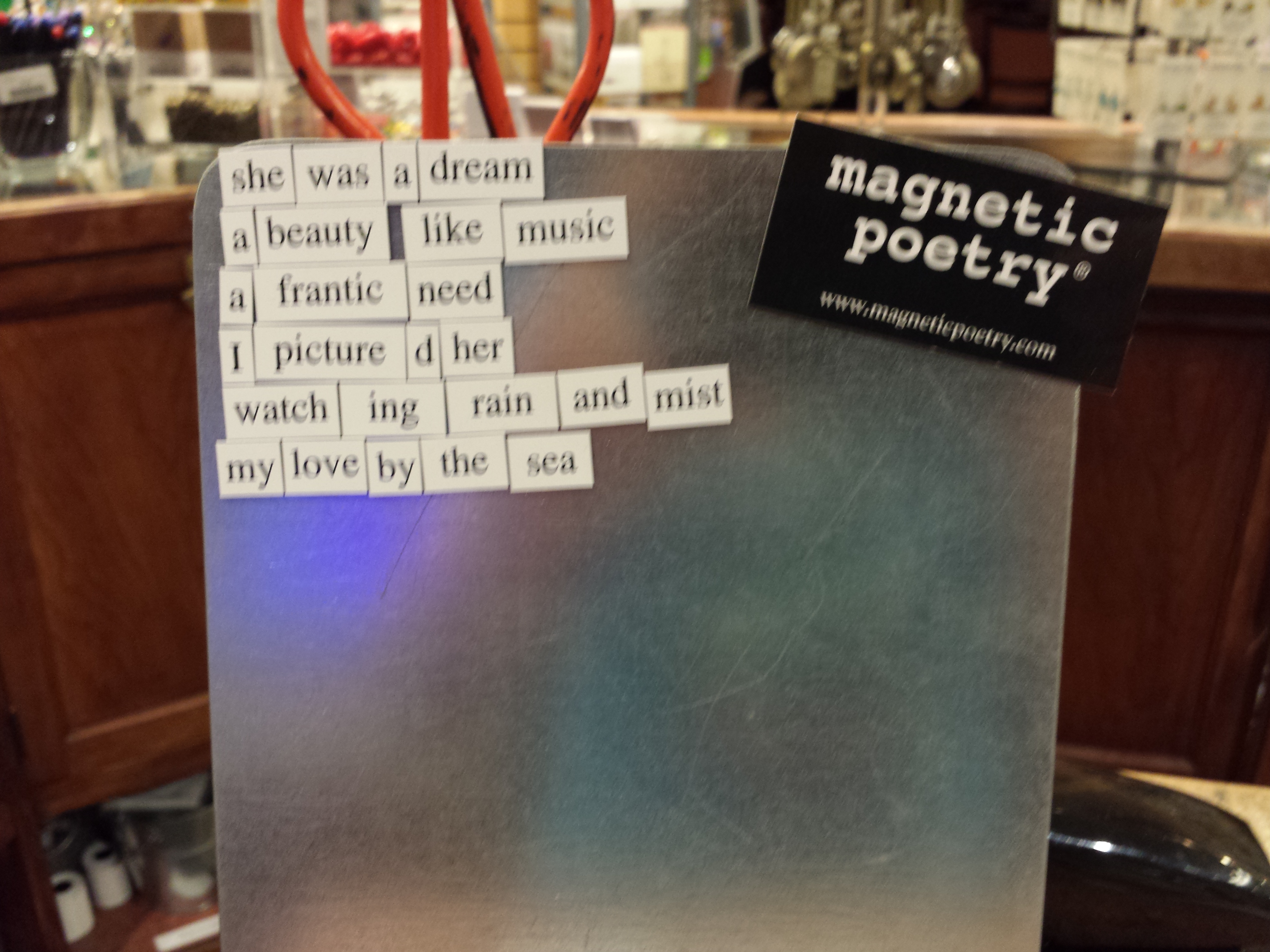
Magnet Poem 3

she was a dream
a beauty like music
a frantic need
I pictured her
watching rain and mist
my love by the sea


Magnetic Poetry copyright info found here.