Skip navigation

Tag Archives: libraries

For this week’s Trifextra challenge, we were prompted to write the origin of a superhero in thirty-three words. I debated doing someone from my favorite comic book series, but then I remembered I had this little thing floating around in my drafts folder, so you get someone original-ish. Enjoy.

The Librarian:

Raised in secret in the catacombs beneath our nation’s capital. Trained from birth in the ways of those who have always walked in silence. He is the peerless warrior of words. The Librarian.


This week is National Library Week, and so I would like to share a few of the things that have been going on at my library.

We’ve had a couple of very successful programs for our local teens. We hosted a Blind Date With a Book, where library books were wrapped in paper and labeled only with a small singles-ad-style blurb.

Happy Valentine's Day, book lovers.

Happy Valentine’s Day, book lovers.

Teens were encouraged to take home a book based solely on the paragraph attached. This sense of mystery allowed for them to be surprised by an author that they may not have encountered, or to unwittingly revisit an old favorite.

Up next was our Readbox display. I’m sure most of you are familiar with Redbox, the DVD and video game rental kiosks.

It's like a Redbox, only better.

It’s like a Redbox, only better.

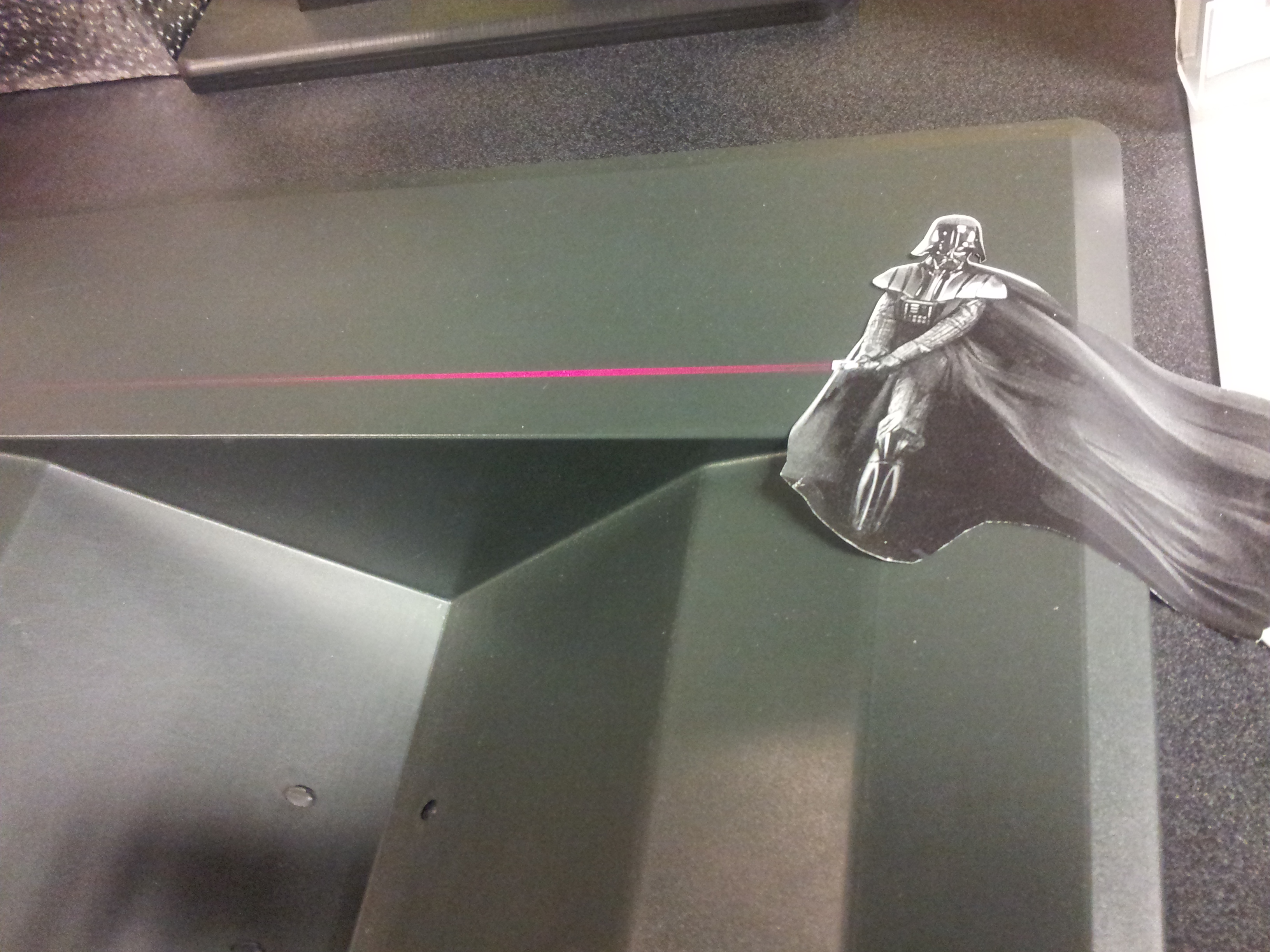
And finally, some days it’s important to just have fun at the library. Nothing helps this like a subtle addition to our self-check station.

"Luke, this is where you scan your library card."

“Luke, this is where you scan your library card.”

If you’ve not visited your local library lately, you should. See what’s new. Libraries are evolving to meet your 21st century needs. Happy National Library Week.

This week’s challenge from Chuck gave us ten randomly chosen words (library, ethereal, storm, dolphin, replay, undertaker, envelope, satellite, chisel, and cube). We were asked to pick five of them to include as elements within the story for a thousand word piece. Here’s “Grave,” featuring library, storm, envelope, undertaker, and satellite, albeit a couple of hours late.

Grave

Lightning crackled across the sky, chasing itself from cloud to cloud as Devlin slung his spade over his shoulder. The storm had been building on the horizon for hours, and the apprentice undertaker had plenty of time to finish his last task, but he’d spent much of his afternoon hiding from his master, Thom. So it was that he found himself crawling out of a newly-dug grave as the first drops of rain began to fall.

Sure, Thom was kind enough on the surface. He’d taken Devlin in several years before, allowing his parents to care for his younger brother and pursue their own careers in archaeology. The old man knew he wasn’t going to be able to carry on his job for more than another year or so, but still, he didn’t have to beat Devlin every time he found him reading. His ears still ached from the boxing they’d been given that afternoon. At least his book hadn’t been thrown away this time.

Digging graves was a bore, always the same dimensions, always the same shovel. The only thing that changed was where in the yard he would be digging. At least the people in the books he read got to escape from their dull lives, off on some adventure. Dev sighed and made his way back to Thom’s cabin at the northern edge of the graveyard. At least the day’s work was done. He called out as he entered the door, the first raindrops hitting the ground as he propped his shovel against the door frame. “Thom? I’m done.”

“Ah, good. I see you managed to beat the storm. Dinner’s nearly ready, if you’ve completed your work.” The senior undertaker stood from a chair near the stove. A fire blazed in the fireplace, lending warmth to the cabin as the temperature dropped outside.

“I did. Mission accomplished, boss.”

“You know it would take you a hell of a lot less time if you didn’t read when you were supposed to be digging.”

“I know.”

“I’m not training you to read all day.”

“I know.”

“Is it going to happen again?” Thom raised his fist.

Devlin sighed. “No, Thom.”

“Good. Glad we talked. Sausage and cabbage soup for dinner. Enjoy. I’m going to bed before the weather gets any worse. Goodnight, Dev.”

“Night, Thom.”

Once the old man had gone to bed, Devlin sat at the table and sipped at a bowl of soup. The week’s mail had come in while he’d been at work and was sitting on the chair beside him, so he picked it up and idly thumbed through the various letters, magazines from coffin makers, and postcards from customers until he spotted a small yellowed envelope with his name on it.

Inside the envelope was a matching piece of paper, a letter in neat handwriting, green ink shining in the firelight.

“Dear Devlin,” it read, “Your father and I are very proud of you. We know that your apprenticeship hasn’t been easy. It’s never easy to have to spend your life doing something you don’t want to do. Still, it’s very important for you to have this opportunity. With the work you’re doing now, you’ll be able to earn a stable living. Who knows? In ten or fifteen years, you might be able to pursue more of your passions.

“You’re very lucky you know. Your brother has to travel to the satellite villages to find work anymore, and no one is about to offer him an apprenticeship. Still, I suppose things could be a lot worse for us right now. Your father and I are busy with our own work, naturally. The excavation of the library is going far better than we’d expected and the scrolls and tomes that we’re finding are in remarkable condition. It amazes me how well the desert manages to preserve artifacts for us.

“We continue to search for the heart of the library. We’ve found a clue that is pointing us even deeper underground. Oh, to have lived at the peak of this civilization! The level of skill it must have taken to be able to create something so massive, a facility of this size, beneath a mountain! Devlin, the words cannot possibly describe the way I feel right now. We’re sorry that you can’t join us. You’d love it here. It’s warm and beautiful, and the chances we have to find something big are growing better by the day. We love you, Dev, and can’t wait to see you. Love, Mum and Dad.

“P.S. Your father is working on some sketches to send when the post goes out again. I hope you like them.”

Devlin set the letter aside. His soup had gone cold, so he poured the remnants out and paced around the dining room. The library. His parents had talked about it for years before leaving for the excavation, and in his childhood he had considered it the stuff of legend. Now here he was, hundreds of miles away, the great desert separating him from them, bound by the terms of his apprenticeship. He longed to join them. There was a sense of finality about the work he did for Thom, with each grave he dug serving as someone’s end. The library was history in the making, each day bringing new discoveries for his parents. Even his brother was finding new things in the satellite villages that surrounded his home.

Dev sighed and sat back down. The terms of his apprenticeship bound him, and Thom was too clever to allow him to sneak off any time soon. As he stretched in the chair, a flash of lightning outside the window illuminated the whole room, throwing his spade into sharp relief. “There is a fresh grave outside,” he glanced at the envelope. “And Thom’s got no family to speak of…” The thunder boomed, rattling the cabin. Devlin sat in thought as the storm raged on and the rain continued to fall. “It is an option…”

Happy Pi Day! It’s 3.14, and that means it’s time to celebrate. Eat pie, count as many digits in that wonderful number as you can, and read Yann Martel’s modern classic about a boy and a tiger.

On an unrelated note, have a nice little discussion about libraries and their future from Cory Doctorow.


In all seriousness, though, I’m writing real stuff for you. It’s coming soon.

February is Library Lovers Month, so I’m going to share a little love for libraries that I found today. Courtesy of the folks over at Daily Infographic, here’s one titled Libraries Are Forever.

libraries-are-forever-972-640x4094

In February of last year, I got the chance to spend a week aboard the USS John C. Stennis, and to my great joy I found the ship’s library in my wanderings of the corridors. This opened my eyes to the surprisingly high number of libraries that exist on ships around the world. Apparently even the Titanic had two different libraries on board. This has made me think about some of the opportunities that would be available to someone who has a Masters of Library Science degree. After all, cruise ships need librarians too… I could work on my tan AND help to educate the masses. There are similar libraries everywhere. This is twenty different kinds of motivating to continue my education. Travel the world without leaving your favorite books behind. Hell, even the Semester At Sea program has opportunities for librarians to serve on their ships.

The MLS degree is still far more relevant than a lot of people think. This article from the American Library Association discusses the outlook for the degree, in contrast to a Forbes article which listed it as one of the worst choices for grad school programs. It may not be the best job line from a purely financial perspective, but, like teaching, librarianship is something people do because they love to do it, not because they want to get rich.

I’m looking at my school options for an MLS degree. I’d like to go back to school this fall, and there are two different programs that I’m considering, both of which are 100% online. I know that it’s something that I’ve talked about for a while now, so it’s time for my words to become my actions. Who knows, maybe I’ll find myself running one of those mobile libraries in the not-so-distant future.

This week marks the 30th anniversary of Banned Books Week, a week-long celebration of the right to read.

Throughout history, books have faced challenges and bans from people around the world. These challenges come from groups and individuals who have taken it upon themselves to determine what is “appropriate” for others to be reading based on tired dogma and personal opinion. In the words of Granville Hicks, “[a] censor is a man who knows more than he thinks you ought to.”

Some of the greatest pieces of literature ever written have been banned or challenged in schools, churches, and public libraries for various reasons. The Great Gatsby, for example (one of my favorite books), was challenged in 1987 by Charleston, South Carolina’s Baptist College because of “language and sexual references in the book.” Now I don’t know about you, but I’m pretty sure that this particular phrase could have been used to challenge the presence of the Holy Bible, considering the Old Testament features several chapters which single-handedly contain more explicit sexual references than anything written by F. Scott Fitzgerald. J.D. Salinger’s classic tale of teen rebellion, Catcher in the Rye, was banned for being “a filthy, filthy book.” That’s a bit of a vague excuse if you ask me, and makes me wonder if the people behind that challenge had actually read the entire book, as, in an amusing twist, the narrator believes a “catcher in the rye” to be one who safeguards the innocence of children. As recently as 2009 To Kill a Mockingbird has been challenged for use of the word “nigger” among other language that was dubbed as inappropriate. The list goes on and on, and increases in absurdity. The works of Tolkien, a staunch Catholic, burned in New Mexico in 2001 as “satanic.” Faulkner’s As I Lay Dying “[b]anned at Central High School in Louisville, KY (1994) temporarily because the book uses profanity and questions the existence of God.”

More recent works are facing challenges and bans as well. Harry Potter, The Hunger Games, and Captain Underpants have all been threatened with removal from library shelves. I’ve personally encountered people willing to ban materials on nothing more than hearsay. My mother, herself a Catholic, has encountered this at the bookstore she owns and operates.
Customer sees Harry Potter on the shelf: “I can’t believe you have that book in your store! It’s about devil worship and magic and terrible things!”
Mum: “Have you actually read the books?”
Customer: “Well, no, but I heard that they were bad.”
Mum: “Well, if you actually took the time to read the book, you’d learn that they’re about a little boy who overcomes terrible adversity and still manages to become a good person despite facing an evil enemy bent on the destruction of the world, and that there’s nothing harmful about the books.”
Customer: “Oh.”
It’s enough to drive a person insane. “The greatest enemy of knowledge is not ignorance, it is the illusion of knowledge.” -attributed to Stephen Hawking

My favorite response to any of these challenges is taken from Oscar Wilde, a man who knew quite a bit about dealing with people who were upset by things that he wrote and did. “The books that the world calls immoral are the books that show the world its own shame.” Humans have an unfortunate history of trying to hide our mistakes and our failures, from the child who attempts to disguise the fact that he wet the bed to avoid the anger of a parent to the government that covers up evidence that it had authorized criminal acts against its own people. It’s human nature, I suppose, but it shouldn’t stop us from learning from our own mistakes. If we hide away all of the bad things that people have done in the past, we can’t do that. You know what they say about learning from the past, and those who are unable to do so.

We need to get over this. If I may be rather earnest, it’s bullshit. Books are here, and they’re being read. If you stop someone from getting a copy at their local library, that might slow them down for a while, but the information, the ideas, are still out in the world. We can’t stop people from experiencing life. Sex and profanity and hate and love and violence are going to be there, whether someone read about it in a book or not. We’ve screwed things up before. Let’s not do that again. 

It’s Banned Books Week. I’m celebrating by reading as many banned or challenged titles as I can. I work in a public library and a bookstore, and I’m providing the people with free ideas and ideas of freedom. “[a]nd ideas are bulletproof.” -V (This V, not that V

In my new position at the public library, I’ve been learning my way around the print reference collection. Let me say this. If a library is a magical place, the reference collection is the source of the power. In my ignorance, I had never ventured behind the reference desk during my initial year at my branch. After spending a mere half hour wandering through the shelves, I realized the error of my ways.

I have been spending my initial training days studying the print reference collection because it is an integral part of our library. Even if most of the searching and problem solving that reference librarians and information services specialists do now is done online, knowing our way around the physical reference section is critical.

Even if it’s only a matter of being able to search for information in the event that the power goes out or the internet is down, I know where I can go to find necessary info for my patrons or for myself. There’s something incredibly satisfying about being able to go to a shelf, pull a book, and open it to the page you need for the data you are trying to find.

A part of me really misses the old card catalogs of my youth. That’s right, folks, I grew up learning the Dewey Decimal system so that I could find a 3×5 card with a book’s call number on it, match the number on the card to a book on the shelf, and take that book to the librarian to check out. Now I understand and fully accept that technological advancements have made it so that a card catalog is now found in a museum rather than a library, but I am still proud that I know how to use it. (I file that accomplishment along with my knowledge of 8-track tapes, rotary phones, and manual transmissions.)

I’ve found all manner of wonderful tools to put to use, both for myself and for others. Here’s a few of them.


I am very pleased to have found copies of books like these on the shelves. I foresee a great deal of free time being spent browsing through the reference collection now, and I am happy to say that research for future projects is going to be a lot more fun than I ever would have guessed.

Since my physical dictionary is still in a cardboard box somewhere (ugh), I’ll have to resort to web sources for this one. Dictionary.com defines a librarian as “a person trained in library science and engaged in library service.” At this point in my life, the term does not directly apply to me. I’m a library clerk, merely a person engaged in library service. The training is still severely lacking, and there’s this piece of paper with a few words on it, like master, library, science, and my name that is still at least two years away. I’m not a librarian. Not yet. It’s a goal, though, and it’s one that I’ve grown more and more serious about in the last few years. One of my coworkers has described it as catching the “library bug” and wanting to get more involved.

My background is filled with books. My parents both read to me and my sisters while we were getting ready for bed. As I was growing up, I would frequently visit the local public library, a site that still plays into a great deal of my writing. We would have story time there, and my sisters and friends and I would always participate in the summer reading program. There was a small local bookstore owned by a couple (quite literally, as they were married at the time) of the teachers that we’d visit on occasion. When they decided that they didn’t want to run it anymore, my parents stepped in and bought it so that there would still be a bookstore in town. After that, the bookstore was my after-school hangout of choice, though I would still stop by the library on the way there. I couldn’t get enough books. I devoured everything that came into my reach.

That’s one of the few things about me that hasn’t changed as I’ve grown older. I love books, and I want to be around them whenever possible. That’s what drew me to work in libraries and bookstores. It’s why I interned for a literary agency, and it’s why I started this blog. I read because I want to read, and I write because I want to write. It’s been said that one should write the book they want to read. That’s very true. I’m going to bathe my life in ink and clothe it in parchment.

I’m going to become a librarian. There’s no doubt of that in my mind. Right now, I just need to be able to support myself and get signed up for the GRE. I’m not looking forward to the test itself, or to the couple of years of grad school that the advanced degree will require, but I am looking forward to finding a way to maintain libraries into the future. I want the world to be a safe place for readers and writers alike, and I want them to know that their work will always have some refuge. Besides, for a writer, what better day job could there be?

For those of you who don’t know, I work in a public library. Those of you who do know me should be aware that I have taken a strong stance against censorship in all forms, especially in the last few years, but it started long ago, back when I first discovered Banned Books Week. Even as a young child, I was a voracious reader, having completed my own trips through The Chronicles of Narnia and The Hobbit & The Lord of the Rings by the time I started second grade. I wanted to read everything that I could get my hands on, and I couldn’t understand why it was that some people would try to keep other people from reading anything.

The process of banning books is a lengthy one. Books are challenged all the time, by parents and religious groups and teachers. Librarians don’t sift through the books they’re acquiring to determine whether or not they should go on the shelves. Librarians (and libraries) promote the ability of the patron to access any information the patron may seek, regardless of personal opinion. Personal opinion should never EVER come into play when determining what works should be available to the public. “When filling their shelves, librarians do not judge the content of books on whether it would be suitable for all audiences. As public institutions, libraries may not discriminate on disseminating information on the basis of age, sex or race, which means that people can check out whatever materials they choose. That said, libraries request that parents and guardians of minors monitor their selections.” -Cristen Conger, How Stuff Works

People come up with all manner of excuses for why they want to ban certain books. This one has violence in it. That one has sex in it. There’s offensive language here. There’s racial insensitivity there. In many cases from my personal experience, however, the people who are attempting to ban a book have not read it for themselves. They have merely taken negative hype surrounding a book and made their opinion solely based on the opinions of others. Yay, sheeple!

Earlier this week, I was at work when a library patron came in, returning a book on playaway that he claimed was “pornography” and demanding that we start the ball rolling to get the book banned from our library. The title in question? Crooked Little Vein by Warren Ellis. Ever read anything by Warren Ellis? This is the guy who created Transmetropolitan, the story of journalist Spider Jersualem, whose character is heavily inspired by the real life of Hunter S. Thompson and who uses a bowel disruptor gun as his weapon of choice. Crooked Little Vein is unabashedly intense. Reading the blurb on the case could have told him that. Thirty seconds on the internet could have told this patron that.

From wikipedia: “Michael McGill, a burned-out private eye is hired by a corrupt White House Chief of Staff to find a second “secret” United States Constitution, which had been lost in a whorehouse by Richard Nixon. What follows is a scavenger hunt across America, exposing its seedier side along the way. McGill is joined by surreal college student side-kick, Trix, who is writing a thesis on sexual fetishes. McGill has to deal with strange events sometimes unrelated to his adventures – he describes himself as a ‘shit-magnet’, with weird phenomena following him wherever he goes…About.com reviewer Jonathan Lasser called Crooked Little Vein “an ace put-up job” and that it was “evidence that freedom is more valuable than repression”. Whitney Pastorek, reviewing for Entertainment Weekly takes pains to note that the work “is not for the faint of heart”, and that Ellis has “got a bright future outside of the picture books”. 

I don’t even know that this patron finished the book. My honest guess? He got too upset because something in the book disagreed with his narrow world view and shut it off. Ignorance is not bliss, people. Ignorance is ignorance, plain and simple. We have to move to the point of object permanence. Hell, two-year-olds understand that covering her eyes doesn’t make mommy disappear. We’ve got way too many heads and not enough sand for this crap to work. Acknowledge that there might be something out there that you don’t agree with, and that it’s not going to go away.

I’m tired of people blaming writers for things that they don’t like. I’m tired of people taking offense at libraries for providing freedom of access to material. Book banning and challenging is a form of oppression of the people. We need to open our eyes, and face the future with courage. Stop book banning. Stop ignorance. Embrace knowledge. Visit your local library and tell them how much you appreciate what they do for you. I’m going to go read Warren Ellis.