Skip navigation

Category Archives: Writing Challenge

The following piece has been crafted for another one of Chuck Wendig’s writing challenges. We were given three lists of ten topics, for sub-genre, location, and included element. Thanks to the luck of random number generation, I ended up with erotic fairy tale, capital city of an ancient civilization, and a magical pocket watch. Here’s “Shambhala” for your reading pleasure. Or just pleasure. 😉


Shambhala

Tick…tick…tick…

Edmund heard the watch before he saw her, long before he knew what it would come to mean. Nitya was her name, and the watch was hers.

Tick…tick…tick…

His cell was cool, but comfortable, with a woven blanket to keep him warm at night. He didn’t know if the others in the expedition had been taken captive as he was or if they had been killed, but he could hear none of them if they were imprisoned. He could hear nothing but the watch.

Tick…tick…tick…

On his first night in his cell, angry, refusing to sleep, he had seen her. Nitya walked the passage, and the sound had been overwhelming, though her bare feet padded silently on the floor. She had been the first person Edmund had seen since he had woken behind the cold bars, the first he’d seen since he had encountered the girl on the outskirts of the city.

Tick…tick…tick…

The watch’s chain glistened in the moonlight, looping her neck once before vanishing from sight. Edmund knew that the watch itself hovered just below the curves of her breasts, though he found himself wondering how he knew. In that instant, she turned and smiled at him, dark eyes shining. “It had to be you,” a soft voice murmured inside his head as she turned to walk away.

Tick…tick…tick…

He had been offered whatever treasure he could find in exchange for leading the expedition, and so he chartered a plane to Delhi, rode for over three hundred kilometers into the Himalayas, and found a small group of men who would attempt to guide him to the ancient city. The map that his financier had provided was in an ancient form of Sanskrit that few recognized and even fewer could interpret, but soon he was deep in the mountains in search of the mythical Shambhala.

Tick…tick…tick…

On the second night, Nitya passed by his cell again, the sound of the watch the only noise. This time, he lay beneath his blanket and watched her until she passed from his sight, entranced by her beauty. She wore no jewelry, barring the watch looped about her neck, and was clothed in a simple sari. Again, she turned to face him, and once more he heard her words, though she never spoke aloud. “I knew from the moment that I first saw you.”

Tick…tick…tick…

“Ask her who she is,” Edmund had said. The expedition had reached the top of a plateau, where an unbelievable sight had greeted them. A lush, verdant landscape opened before them, trees and ferns and flowers the like of which had never been seen were flourishing here in the harshest mountain range on Earth. In their midst stood a small girl, black hair cascading over her shoulders. She said nothing, but simply stood watching the men. Finally one of Edmund’s interpreters spoke up, speaking first in Hindi, then Urdu, and finally (after a suggestion from Edmund) Sanskrit. At this third attempt, the girl had smiled and raised one hand, as if in greeting. Edmund felt himself growing tired. The last thing he saw before his eyes closed was the flash of a golden chain about the little girl’s neck.

Tick…tick…tick…

Could she possibly be the same girl? Edmund’s mind raced. The chain was the same. It had to be. It was the only possible conclusion. That meant, however, that Nitya had been responsible for the fate of his companions, whatever that might have been. The day passed in a confused blur of sleep and hunger. When he awoke with the moon on the third night, he found a small cup of water on the floor beside him. He sipped slowly, knowing that the ache in his stomach would only be worse if he didn’t pace himself.

Tick…tick…tick…

She was coming. The moon was waxing, and Nitya was drawing near. The sound of the watch grew louder. Was it really the third night that he had been locked in this cell? Time seemed to lose its natural rhythm. Was the moon waning now? Edmund could no longer be certain of anything. She had passed into his field of vision, and once again she paused before him. “I have been waiting my entire life for your arrival,” she said without speaking. “My father, King Suchandra, told me that you would come, but he has been gone for over six hundred years, and the Kulika now rules here.” She smiled again. For the first time, she opened her mouth and Edmund heard her voice with his ears. “Hello, Edmund. I am Nitya. And it is time that you were freed.”

Tick…tick…tick…

Edmund stood outside of the bars of his cell for the first time. Nitya stood beside him, an ivory and gold sari wrapped around her. “Welcome,” she said. “Welcome to Kalapa.”

“W…where am I?”

“Kalapa,” the woman repeated. “Capital city of the great realm of Shambhala.”

Edmund stammered again, confusion and disbelief mingling on his face. “S…Shambhala?”

“Is this not what you have sought? Was it not your wish to find this place?” Nitya’s voice was soft and mysterious, unmistakably feminine but with deep, dulcet tones and an accent akin to that of Edmund’s Sanskrit interpreter. When he said nothing, Nitya continued. “I see. You searched for my home, but you did not believe. You did not know that such a place could possibly exist.”

Tick…tick…tick…

“What happened to the rest of my men?” Edmund demanded, finding his voice at last.

“They have been sent away, returned to their families with no memory of this place, or even of you, Edmund.”

“How?”

“The watch,” she replied, reaching beneath the sari to reveal a golden pocket watch attached to the chain. “It grants me some control, within the boundaries of Shambhala.”

Tick…tick…tick…

Edmund blinked and found that he was now standing in the middle of a sandalwood grove, an enormous mandala towering over him. Nitya was at his side.

“This was my father’s garden,” she said. “And now it is mine, to share with the one that I deemed to be worthy. So it is that I saved you from your companions and brought you here.”

“Were you the little girl that we met at the edge of the city?”

“I was,” Nitya nodded, “but when I saw you, saw that you were of your age, I knew that the form I had taken to greet you was too young to welcome you properly. The watch accounted for this as well. And now,” she continued, “I am ready.” Nitya crossed her arms, taking the edges of the sari and pulling them down, exposing the full, smooth curves of her breasts. “I have waited for centuries, Edmund. Waited for the one with whom I could share the fullness of maithuna.” The sari fell away from her body as she stepped toward him, placing a kiss on his lips. “Do you understand now?”

Tick…tick…tick…

Edmund’s heart was racing as he wrapped his arms around her. “I came here to find  you, didn’t I?”

“You came here because I desired it,” Nitya whispered, unbuckling Edmund’s belt. “You came here,” she kissed his neck, “because I desired you.

“Why me?” Edmund was gasping as his arousal grew. Nitya’s hands reached into his pants, pulling them down.

“You have the kundalini,” she said. “The sleeping energy. It is only waiting for you to reach the proper understanding, to awaken, for release.”

Edmund lifted his shirt over his head and tossed it to the ground as Nitya’s hands came to rest on his back. “The energy is here,” her fingers traced lightly over the base of his spine, “but you are yet unprepared.”

Tick…tick…tick…

Edmund lay naked on a bed of sandalwood, the moon now full overhead. Nitya knelt behind him, slowly massaging a fragrant oil into his skin. She chanted quietly in a forgotten tongue, her hands helping him to relax.

“If you fight, Edmund, if you are unprepared, the awakening can be most unpleasant. Breathe deeply now.” For what seemed like hours or days or months, her hands caressed him, until finally Nitya ran her index finger up his spine, placing a kiss at the back of his neck. Edmund felt a tingling race along his back, following the path Nitya had drawn, and his eyes flashed open. “Now.”

Tick…tick…tick…

“Now,” Nitya whispered, “maithuna, the union.”

Edmund rolled onto his back as Nitya climbed onto him, slowing lowering herself and moaning with pleasure. The watch swung on its chain as Edmund kissed her breasts, as he tasted her, as he filled her. Time fell away as they came together, again and again, the moon waxing and waning above them as energy surged between their bodies.

Tick…tick…tick…

“Your life outside of Kapala is now over, Edmund. Your time in the world beyond Shambhala is at an end, but your time with me is only beginning.”

Edmund and Nitya kissed beneath the pale glow of the moon.

“Then I shall stay,” he said. “I shall stay.”

This is my entry for Chuck Wendig’s latest weekly flash fiction challenge, which asked us to write what we know, but with a fictional twist. Here’s “Before the Dawn” for your enjoyment.

My father wakens me before the dawn. I dress myself in the dark, preparing to go to work with skill born of endless days of practice. Within minutes I am ready, and I leave my bedroom to find my father seated at the kitchen table, a cup of coffee before him, a glass of orange juice at the seat next to his. I sit beside him, questioning him about the day ahead of us and what it might bring. He is tired, though he tries not to show it. Work has been hard on him for the past few weeks, more so than normal. It’s harvest season, and it’s nearly over.

I glance out the window and I can see the last traces of the second moon fading as the sun peers across the distant horizon. The red tinge of our world is barely noticeable in the larger cities like Valentine, but out here, Mars is still Mars,  and it still feels like home. My family and I have lived here my whole life, and soon I will come of age, but not yet. I find myself dreaming of Earth sometimes, but I am grateful for the opportunity to be where I am. My mind drifts to what a boy my age on Earth would be thinking as my father tells me that it’s time to go.

We climb into the truck and head north, toward the field that we finished cutting last night. Since the terraforming, wheat has grown better on Mars than it did in the last hundred years or so on Earth. We’ve got almost a thousand acres left to harvest, but our crew is great this year. Two of my uncles, my grandfather, and a small army of cousins will be reaching the field soon, but since it’s one that’s close to our house, Dad and I are the first ones there.

I stretch as I climb out of the truck. A cool breeze is blowing across the stubble, and I think about how wise it was to bring a thermal sweatshirt this morning. Dad is already starting his half of the pre-harvest tasks, preparing the combine for operation. The equipment that we use was manufactured here on Mars, assembled by my grandfather and his brother from pieces that were printed upon their arrival on the planet. It was the only practical way to get the necessary machinery to another world, and it was achieved using Martian minerals. The technique had proven itself on Luna, and had only seen improvement by the time the terraforming process was complete on Mars.

My side of things is relatively simple. As has been my job since I was thirteen, I prepare the grain cart and the tractor that pulls it. I pull our truck alongside the tractor, lining up the fuel tank in the truck’s bed with the  tank on the side of the tractor. Once the fueling is in progress, I grab a grease gun and a rag from one of the tool boxes and begin the hunt for the the various zerks that are found on bearings around the tractor and the auger on the grain cart. Dad likes to tell me that farming has changed very little since he was my age. The only real difference is in location. And a little bit of gravity.  Okay, quite a bit of gravity.

I jump up to the top of the auger, greasing the bearing there before dropping back to the ground. Greasing the grain cart takes about ten more minutes, and the fuel pump clicks off just as I’m finishing up. As I’m wrapping the fuel hose back around the pump, the rest of the harvest crew arrives to service their machines. A swarm of family members pours out of a handful of other pickups, quickly preparing the other four combines, the tractors and grain carts, and the semi trucks that will haul the wheat away.

As the sun rises higher, the crew piles back into their various vehicles to make the move to the next field. We’ve got a fifteen kilometer trip there, so we form up into a convoy with the combines at the front and the pickups at the rear. At the max speed for the combines, it takes us about forty-five minutes. Upon our arrival at the new field, my grandfather takes the lead with his combine, cutting a small swath in the corner of the field where the rest of the vehicles will initially park. Once he’s done, he begins to cut a path through the wheat at the field’s perimeter. My father and uncles and one of my cousins follow suit, taking the next header width in. As my grandfather finishes his first round, the hopper on top of his combine is nearly full. It’s a good sign of the quality of the wheat, a sign of a good yield on a field this size.

Seeing this, I slip my tractor into gear, driving across the stubble to line up with the now-extended auger on the combine, matching my speed to his as the auger begins to feed wheat from the combine into my grain cart. My cousins fall in alongside the other combines, and as each grain cart is slowly filled we peel away to transfer our loads to the semis.  When the semis are in turn filled, other members of the crew will drive them to a storage facility on the outskirts of Valentine, about twenty-five kilometers away. It’s a familiar operation, one we’ve carried out every summer for as long as any of us can remember. We stop in shifts to eat packed lunches in our tractors and combines, and the day goes smoothly. Soon we will have provided a good portion of the wheat necessary for the growing colonies.

Dad calls me over to his combine as the sun begins to set and Phobos and Deimos appear in the sky.

“Good work today, sonny boy,” he says.

My entry for my Hallowe’en Writing Challenge is here. Thank you participants, and Happy Hallowe’en.

“The Last One”

The fire had died down too much during the night, but it couldn’t be helped. I’d been in desperate need to rest after three straight days of running from them, and Marcus had been caught by them partway through the second day, so there was no one to share the watch. His screams had followed me, even into sleep.

As soon as I woke, I scrambled for a handful of twigs, leaves, and sticks to rekindle the flames, knowing that they were the only thing that would really keep them away. Once the fire was beginning to burn in earnest, I checked the gun I’d managed to grab from the facility guard’s body, a Colt 1911. “Only four rounds left,” I sighed as I checked the magazine. The .45 had been effective against them so far, but there were so many of them. Only one of us, me, now that they’d gotten Marcus. I sighed again, managing once more to hold back the tears that had threatened for the last day and a half, and chambered a round.

“He’s gone. Get over it. Get up, and get moving.” I added a small branch to the fire, watching as the flames kissed and embraced it, growing larger and brighter. As I listened for footsteps in the distance, I reflected on the past few days and marveled at how quickly everything had fallen apart.

We’d joked  for years, about how we couldn’t wait for it, and how our lives as video game geeks had prepared us for this exact situation. Well, let me just tell you that nothing, and I mean nothing can prepare you for the sight of your best friend being swarmed and eaten by those…things. We said that we’d make it through together, and now…I put my first three bullets into their heads. The fourth went through Marcus’ eye when I realized he wasn’t going to get away, when he realized what would happen if I didn’t.

The fire had scared them away, we didn’t know why, and I still don’t. I had the Zippo Marcus had given me for my eighteenth birthday, even though I didn’t smoke. I told him his habit would kill him. He said my nagging would be the death of him. Well, we were both wrong, but he was closer.

A crack of a twig breaking snapped me back to the present. They were here. I’d not gotten the fire started in time, and now they were here. “Son of a bitch,” I muttered, grabbing the burning branch in my left hand and the Colt in my right. They were getting closer, surrounding me, but there was no way in hell they could know what my plan was. I knew I wasn’t going to survive, but I was going to take as many of them with me as I could. I fired my first three shots as they came into view. I dropped my torch into the dry leaves and raised my gun to my head.


Halloween is nearly upon us, with NaNoWriMo close on its heels, and that thought absolutely terrifies me. In the spirit of the season, I’m taking a page from Sonia M and asking my readers to take part in a writing challenge. This is the first challenge I’m hosting, and so it is going to focus on my favorite holiday. Craft a piece of horror-themed microfiction. Think Poe, Lovecraft, King, Machen, condensed into roughly 500 words.


The rules are simple.

1.) Theme: Write a horror-themed piece of microfiction.
2.) Genre: Other than the overall theme, there are no genre limitations. Write a steampunk/horror story, or a horror/romance, or science fiction/horror, just for some examples.
3.) Word limit: 500 words (approximate).
4.) Deadline: October 31st, 2012.
5.) How to submit: If you have a blog of your own, post your story on your blog and share a link in the comments on this post. If you don’t have a blog of your own, feel free to post the story in the comments here. If you do this, I will post the story in a separate post and re-link it here.
6.) Prizes: The reward of a job well-done and the knowledge that you managed to finish one more short piece before diving headfirst into NaNoWriMo.

I am challenging myself to do something I did three years ago (oh good god, was it really three years? Now I feel old). Back in 2009, I was a senior in college, and I was having the time of my life. It was about this time that I remembered an old rhyme. It goes something like this. Thirty days hath September, April, June, and November. All the rest have thirty-one, Excepting February alone, And that has twenty-eight days clear, And twenty-nine in each leap year. (wikipedia) This floated into my head just before September started, and so I decided that I would turn it into “Thirty Poems Hath September” and write one new poem for each day of the month. It was kind of like Nanowrimo before I knew that Nano existed (it was a dark time in my life, despite my earlier statement). At any rate, I composed a LOT of poems that year, mostly during the medieval literature class that V and I were taking at the time (sorry, Dr. Napierkowski-no offense to you or your class, that was just when I usually felt the most inspired). Some of them were complete nonsense. Many of them were haiku, because I would realize I only had five minutes left in the day to write a poem. Some of them were really good. Regardless, the idea got me to write, and to focus on some creative energy that was otherwise fairly elusive. I would recommend you try it. Thirty Poems Hath September. Get ready.

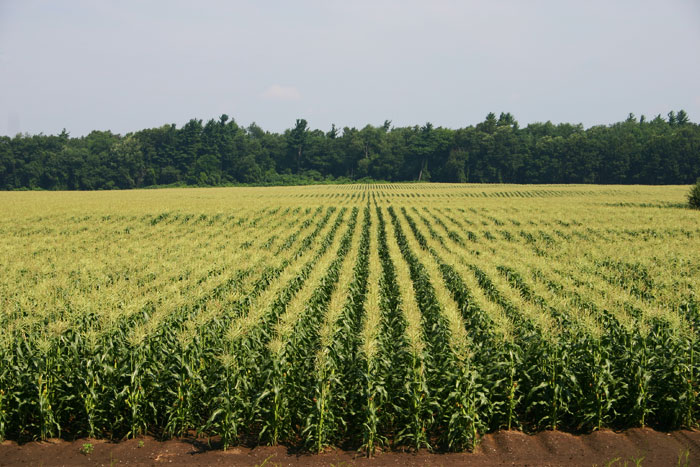
This is my entry for Sonia’s latest writing challenge. The summer competition gave us the goal of writing a short story (500 words or less) based on a photo. Here’s “Corn.”


Green is everywhere. It’s the first thing I see when I wake up. There’s been rain recently, and I can feel the moisture in the soil, smell it all around me. Rain’s scent lingers in the gentle breeze. The thunder’s rumble in the distance matches the one in my stomach, and I realize how far the storm has gone and how long ago my last meal was.

Corn. That’s the other overwhelming smell. Damp corn leaves. The corn is tasseled, but the ears on the stalks are still immature, still some time away from being ready for harvest. Good. I don’t have to worry about some poor farmer coming across me when I’m in this state. It’s unlikely that anyone will be coming through the rows this time of year, though. The stalks are far too tall for any wheeled vehicle to come through without crushing them, at least aside from a combine, and again, the maturity of the ears has already eliminated this possibility. I’m not certain where I am. The sun is still all but invisible behind the heavy clouds, but its position tells me that it is early evening. The worst of the storm must be moving on to the east of me, carrying with it more than any farmer would ever want. A heavy green tint to the rear of the storm system hints at the hail that lurks within. I turn my eyes toward more immediate dangers.

My backpack, or more accurately a backpack with my name on it, is on the ground, a row to my right. Examining it for any signs of tampering, I find none. It seems to be fine, so I open it. Inside, I find a flashlight, a jacket, a pocket knife, and a plastic bag with a piece of paper in it. The paper is folded four times and is written upon in black ink. The simple script reads “You have until sunrise tomorrow. You know what you have to do.”

I shrug and nod, fairly certain now that my every move is being watched, despite the apparent solitude.

Without further thought, I shoulder the backpack and stride into the green, vanishing between the rows. I leave boot prints in the damp earth behind me, following the setting sun.

I hope that I can make it.

Each month, the wonderful Sonia M. over at doingthewritething presents her fellow bloggers with a writing challenge, usually to create a piece of microfiction that fits within a particular word limit and based on a simple prompt. It’s a great way to connect with other writers, and it can only help to boost your creativity. Isaac Asimov even wrote under similar limits, once crafting a short piece of fiction designed to fit on the back of a postcard. The man was a genius, but I digress.

This month, Sonia’s challenge for us was “First Impressions and Famous Last Words.” We were allowed to write any genre, but we were limited to one hundred words and told to create either the opening or closing lines to a story. Here’s my contribution.

*     *     *     *     *     *

The explosion shook me off my feet, hurling me into the bulkhead. The airtight doors around me began to seal, red hazard lights flashing as artificial atmosphere vented. I scrambled for my emergency oxygen mask, knowing that precious seconds would make the difference between living and dying. As soon as I was breathing normally, I looked around again, pleased that my training had saved me but terrified of what could’ve caused such a catastrophic failure in the compartment. My communicator was still attached to my belt, but it had been damaged in my fall. No signal. I was truly alone.

*     *     *     *     *     *

Was it the first or last hundred words of a story? I don’t know. I like that it could be either one.

Well, another month has come and gone, and that means that it’s time to post another writing challenge entry for Sonia M’s monthly challenges. I missed last month’s, due to my travels and being cut off from the internet for a while, but I’m back. Our topic this time around was “Make a Wish.” With that in mind, I decided to write this for you. I hope you enjoy it. Here’s “What Price Happiness?”

* * * * * * * * * * * * * * * * * * * * * * * * * * * * * * * * * * * * * * * * *

Did it really count as a wish? Maybe so. I always thought of it as more of a foolish kid’s dream, but hey, what else do kids do? We dream, and we make wishes. We hope against hope that things will turn out better for us. We don’t think about consequences when we’re young, and some of us don’t think about them even when we get older. And if the joy we wanted turns out to only come at the cost of misery for those we love? If we’re lucky, maybe we stop depending on wishes, and start trying to make changes for ourselves. Sadly, all too frequently I have found that I have been scrambling to undo the damage that I felt I had caused.

Does trying to fix things count as learning a lesson? I don’t really know. I’m still trying to figure out when this went all “Monkey’s Paw” on me. I’ve lived my life trying to avoid regrets, ever since the day that I met her. Even now, years later, her words still echo in my head. “I said I knew that it was a mistake. I never said I was sorry I made it.”

Am I happy now? Honestly? No, I’m not. I should’ve known I wasn’t going to be the one paying the price for a wish that I never even intended to make. I guess it’s too late now, the words are probably meaningless, but I can at least say that I’m sorry.

Yes, I have Lovecraft on the brain. GET IT OFF!

Whew. So, Miss Sonia’s latest writing challenge is this: fifty words from one word. Mine was Euclidean. Enjoy.

Non-Euclidean geometry, they called it. It’s a mind screw. I think that’s kind of the idea. I’m not too sure how long I’ve been here now, and I have no way of knowing if there’s any way out of these damned Escher staircases. Too late. I can hear them coming.

Greetings, readers and fellow NaNo participants! Having already topped 1,000 words on the day, I’ve taken a slight break from all of the insanity of the first day of my first ever attempt at National Novel Writing Month to share something with you. This is not the original story I’d planned to post for Sonia M’s October/November writing challenge. I was going to go with something a little more tilted for yesterday’s mood, and you may still get that at some point. This is something that I crafted within the last half hour or so. Call it a writing sprint. I’ve prepared another piece for you that I hope you all enjoy. I present “Masks” for your reading pleasure.

Masks

“It’s not who you are,” she spat. “It’s who you keep pretending to be. Why can’t you just be yourself when you’re around them?”

I pondered this, not wanting to fuel her anger. She was upset enough as it was. “I dunno,” I replied. “Honest. I don’t even realize that it’s happening. I guess I’ve just been hiding things from so many different people for so long that I don’t even make a conscious effort to do it anymore.”

“What the hell is that supposed to mean?” Her hands were alternating, sometimes crossed over her chest, other times on her hips. Probably something to do with her uncertainty of emotion. Anger and compassion were dueling inside her head, and the movement she made was my only hint as to who was winning at any given time.

“You say I put on a different mask for every group of people I’m around, and I guess that I can believe that. I mean, to one circle of friends, I am a slightly different person, and then there’s my family, and even there I suppose there’s a different face that’s presented to my parents versus my sisters versus my cousins and whatnot.”

“You’re just now realizing it?” Chest.

“It seems that way…”

“Then what’s going on when we’re together?” Hips. Uh oh.

“When I’m around you, it’s like I can take the masks off. I don’t need them around you. Who I am when I’m with you is probably the closest I’ve been to my true self in years.”

“And I’m supposed to just accept that? Do you even know who you are?” Still hips. Defcon 2.

“Yes?”

“ARGH!” She stomped away briefly. “Can you at least give me an answer?”

“I don’t remember who I used to be. I’m fairly certain that I’ve been hiding myself from everyone for so long, that I can’t remember what my own face used to look like.”

“Why?” Chest. Maybe still a chance for redemption in this conversation.

“I got made fun of a lot as a kid. I thought we talked about this before. I was the easy target, I guess, maybe because I never had what it took to be an athlete. People seemed to think that was the only way out of my home town. Maybe they thought I was doomed, and so they were trying to toughen me up. Maybe they just didn’t like dealing with someone smarter than they were. The first ‘mask’ I would’ve put on would’ve been to hide the fact that it hurt when they said things like they did.”

A hug. I guess that I’d at least said something right.

“You never got over it, did you?”

“I’m not sure. I think I’ve moved past it, but I still put on these other faces when I’m around them.”

“Then it’s time to change.” She took my face in her hands. “And I know just how to get that first mask off,” she said as she kissed me.