Skip navigation

Category Archives: Books

Required reading. It’s a phrase that strikes fear in the hearts of lesser men and women. Despite the delays that my undergraduate career caused for my reading list, I encountered some of my favorite works of literature during those years. I had numerous lists of required material for my classes in college, and I can honestly say that my tastes have changed for the better because of it.

Some of my favorite pieces of required reading from my college courses are listed here.

Beowulf (translated by Seamus Heaney). My medieval literature professor had us read this one. I knew the story prior to taking the course, but I’d never read Heaney’s translation. Heaney maintains the verse form of the original text, but makes the legendary tale accessible to modern readers. Follow the adventures of Beowulf, mighty warrior, as he does battle with monsters and becomes a king. Side note: kennings are awesome.

Fun Home by Alison Bechdel. Bechdel’s art recreates memories of her childhood in the family-run funeral home. Along the way, she reflects on her coming out as a lesbian and explores her recently-deceased father’s reasons for hiding his own homosexuality from his family. This graphic novel and its follow-up, Are You My Mother? are fantastic. Solid writing, honest prose, and intricate drawing make Bechdel’s works must-reads. My many thanks to my American Literature professor for introducing me to her writing.

The Giver by Lois Lowry. This was one I’d read a couple of times since first encountering it in audio book format on a family camping trip as a kid. When I learned that it was on the list for a sociology class I was taking, I wanted to thank the professor for picking something that so beautifully described a small, isolated community. Jonas’ selection as his village’s new Receiver of Memory is the first step in his realization that life in his home is not as ideal as he believes.

That’s it for now, folks, but I may make another post or two along these lines. Remember, literacy is our friend, even if it’s forced on us.

In 1977, Stephen King chilled readers with a tale of a young couple and their son, and the worst winter to ever pass in a hotel in Colorado. That book, The Shining, was King’s third novel, and thanks in part to the brilliant work of Jack Nicholson and Stanley Kubrick, is widely remembered as the basis for one of the greatest horror films ever. Now, almost forty years have passed since The Shining first hit shelves, and we are granted a rare treat from the master of horror. On September 24th, 2013, Stephen King released Doctor Sleep, a sequel to one of his earliest and most famous novels.

One winter, long ago, one of Colorado’s finest hotels burned to the ground after the aging boiler exploded. Four people were at the Overlook Hotel at the time. Jack Torrance (the recently hired winter caretaker), his wife, Wendy, and their son, Danny (a young boy gifted with the titular “shining”, a type of psychic power), were living in the hotel for the season. Also on location was Dick Halloran, head cook of the Overlook, who had returned from vacation in Florida because of a growing concern for the safety of the Torrance family. Mr. Torrance was killed in the blast while the other three escaped with relatively minor injuries. Torrance had reportedly returned to the hotel’s basement in an heroic attempt to relieve the pressure in the boiler, albeit regrettably too late to save the hotel and himself. The truth of that winter is known only to the survivors.

Years later, Danny Torrance is a grown man struggling with ghosts, both literal and metaphorical. Having inherited his father’s propensity for alcohol, Dan tries to hide from his past, locking away the memories of the Overlook and drinking to numb his psychic abilities, always on the move from town to town. After a time on the road, bouncing from bottle to job and back again, Dan realizes that he has to get his life back together. In a small town in New England (surprise!), Dan finds an AA sponsor and gainful employment at a local hospice. Before long, he’s learning to use his shining to help those who are near death to cross over to the other side, earning the nickname “Doctor Sleep.”

Far across the country, a group of people known as The True Knot are stalking people with shining, feeding off of their powers and extending their lives. They soon set their sights on a young girl named Abra, whose latent shining is a blazing fire next to the flickering match that is Dan Torrance’s power. The True intend to find the girl, torture her to death, and feast and rejuvenate on her power, or “steam.” When she learns of their existence and their plans, Abra reaches out via the shining, attempting to find someone who can help her stand against the True, and finds Dan. Soon the two are communicating, planning a way to defend Abra from those who would do her harm and simultaneously lay Dan’s ghosts to rest once and for all.

King has crafted a delightful tale with Doctor Sleep, continuing the story of a tormented young boy as he passes into adulthood. He skillfully weaves new and old, tying details of The Shining into the present-day narrative. It’s not The Shining all over again, but rather a different, more mature type of horror. Dan is sympathetic, and overwhelmingly human, struggling to flee from the gifts that saved his life when he was a child. Abra is a bright spot in his life, reminding him of the hope his family once had.

If you’re a Stephen King fan, odds are that you’ve already at least considered giving Doctor Sleep a read. I devoured it, and as always, I wanted more when I was done. It’s a fascinating opportunity to see the evolution of King’s writing style and technique, and a great story in its own right.

It’s almost the end of September, and another favorite time of year is here. This year, Banned Books Week runs from the 22nd to the 28th. For you uninitiated out there, Banned Books Week celebrates the freedom to read. You see, some people in the world are so terrified of knowledge that they actively seek to hide information from other people. In some unfortunate cases, this results in people attempting to remove a book from public access. In response to this behavior, the American Library Association started Banned Books Week, an annual celebration of free and open access to information.

I’m not going to mince words. I fucking hate people who push for the banning of books. It is the one thing that gets me upset more than anything else. It is an act of supreme ignorance to ban a book. No one should be able to tell someone else that they can’t read something. Period. In fact, I’m rather stubborn about it. If you tell me that I shouldn’t read something, I’ll ask you why. If you tell me I CAN’T read something, I’m going to find a way to read it.

So, why do people ban books? Most challenges to books occur in schools. This frequently has to do with a book that a class has been assigned to read having some content in it that a parent or guardian of one of the readers finds offensive. Case in point: Judy Blume’s Are You There, God? It’s Me, Margaret is a frequently challenged title. This is usually more because it includes a description of a girl having her first period than because it is about said girl’s questioning of the existence of a deity. Yeah, that’s right, kids. Talking about the changes that EVERY HUMAN BEING goes through are apparently reason enough to stop someone from reading a book. HOW DARE YOU CHILDREN ATTEMPT TO LEARN WHAT YOUR BODY IS DOING!

But yeah, “sexually explicit” and “unsuited to age group” are the two biggest reasons cited when someone challenges a book’s presence in a library. That’s because both of these terms are open to a very loose interpretation. If a parent feels that their precious little snowflake of a child isn’t ready to read about something that everyone else in their class at school has been talking about, then BAN THAT BOOK. Guess what, folks? Mitch Hedberg said it best. “Every book is a children’s book if the kid can read!” Look, if you’re concerned about what your kid might learn from a book, talk to your kid about the topic. It’s called parenting. The librarians aren’t there to do it for you. They’re there to provide information to their patrons, not to keep them from accessing it.

Why should I care? Orwell left us this gem in 1984. The oppressive regime in control of England in the book uses several slogans, including  WAR IS PEACE, FREEDOM IS SLAVERY, and IGNORANCE IS STRENGTH. It’s quite telling, and a bit terrifying, that 1984 has itself been challenged. We’re living in a world where our ability to access information is greater than ever. Thanks to the internet, we have an unbelievable amount of data that we can use every day, WHENEVER WE WANT. However, there are people who want to limit this sort of access to those things that they feel are appropriate for us to see. Sound familiar? People who want to ban books are proponents of ignorance. Fight them. Peacefully.

What can I do to help? Learn your library’s policy on reacting to book challenges. If someone says that they want to complain about a book, ask them if they’ve read it (Yes, this is a legitimate issue—most of the people I’ve met who complained to me about Harry Potter, for example, had NEVER ACTUALLY READ THE BOOK). Many complaints are based purely on hearsay. I like to think of this as the “Cycle of Stupidity.” Some day I’ll draw you a nifty illustration as an example of the cycle. For now, let it be known that only you have the power to stop stupid people. Fight the spread of ignorance. Embrace literacy. Read a banned book. Judy Blume has a great strategy for getting a kid to read. “The best thing to do is leave the books around the house and from time to time say, ‘I really don’t think you’re ready for that book.'”

Other people can stand where they like on the issue of reading freedom, but me? I’m with the banned.

I recently finished Chuck Wendig’s first novel for young adults, Under the Empyrean Sky. As a fan of Chuck’s blog over at Terrible Minds, I felt I owed it to myself to give one of his full-length books a read, and I’m damn glad that I did.

Under the Empyrean Sky introduces us to our intrepid young hero, Cael McAvoy, captain of a teenage scavenger crew in the Heartland. Cael and his friends sail a land boat across the seemingly endless fields of corn to salvage anything they might be able to sell in their home town of Boxelder, because any extra money they can bring in helps provide for their families.

See, only one thing grows in the Heartland. The Empyrean makes sure of it. Hiram’s Golden Prolific is a modified strain of corn that spreads anywhere it pleases, choking out any other potentially competitive life (and it’s not fond of people walking near it, either). It’s the only seed that the Empyrean distributes to the farmers in the Heartland, and the returns for working for the Empyrean machine are enough to barely survive.

So Cael McAvoy scavenges, but he and his friends are not the only crew at work. The mayor’s son has a crew, number one in salvage recovery in Boxelder, and Boyland Barnes Jr. brings daddy’s money to the fight to ensure that Cael’s crew remains in second place. With tensions running high as the Harvest Home festival approaches, Cael takes his ship out for a prime target, only to be shipwrecked in the corn by Boyland Jr. It’s then that he finds something out in the middle of the field, something no one in the Heartland could have predicted. Vegetables. Fruits. Things that have no right growing in the midst of Hiram’s Golden Prolific. The discovery could make them all rich enough to buy passage to one of the flotillas, massive hovering cities of the Empyrean, where the wealthy live in splendor floating over the Heartland like Cael’s boat over the corn. Or it could get them and everyone they’ve ever loved killed.

Wendig packs one hell of a punch into the pages of this book. Deep characters and rich world building blend seamlessly with gritty violence and some of the most honest dialogue to hit the pages of a young adult novel. While some things might come across as a bit heavy-handed (like Empyrean agent Simone Agrasanto‘s name), most of the novel is quick and sharp, like the leaves of the plant that lends its name to Wendig’s self-dubbed “cornpunk” genre. Under the Empyrean Sky weaves teenage love, sex, violence, and intrigue into a wild land boat ride that will leave you counting the days until the release of volume two.

Last week I wrote that I had made a trip to Denver to purchase a copy of Neil Gaiman’s new novel, The Ocean at the End of the Lane. On Tuesday, I returned to Denver with my new book (which I had just finished) and my copy of The Annotated Sandman Volume One tucked safely away in my messenger bag. Along with two of our other friends, V and I trekked down the 16th Street Mall to the Lodo Tattered Cover and joined the queue.

While we arrived too late to be seated in the room where Neil was speaking, we were able to find space on the carpet of the second floor, where the audio was being broadcast over the sound system. We got to listen to him read an excerpt from his new book (he also reads the audio version, and given the autobiographical tones, no one else could have) and answer a handful of questions from the audience. After describing his life as “realism splashed with the supernatural,” it was time for the signature line to form.

First up, the new book.

First up, the new book.

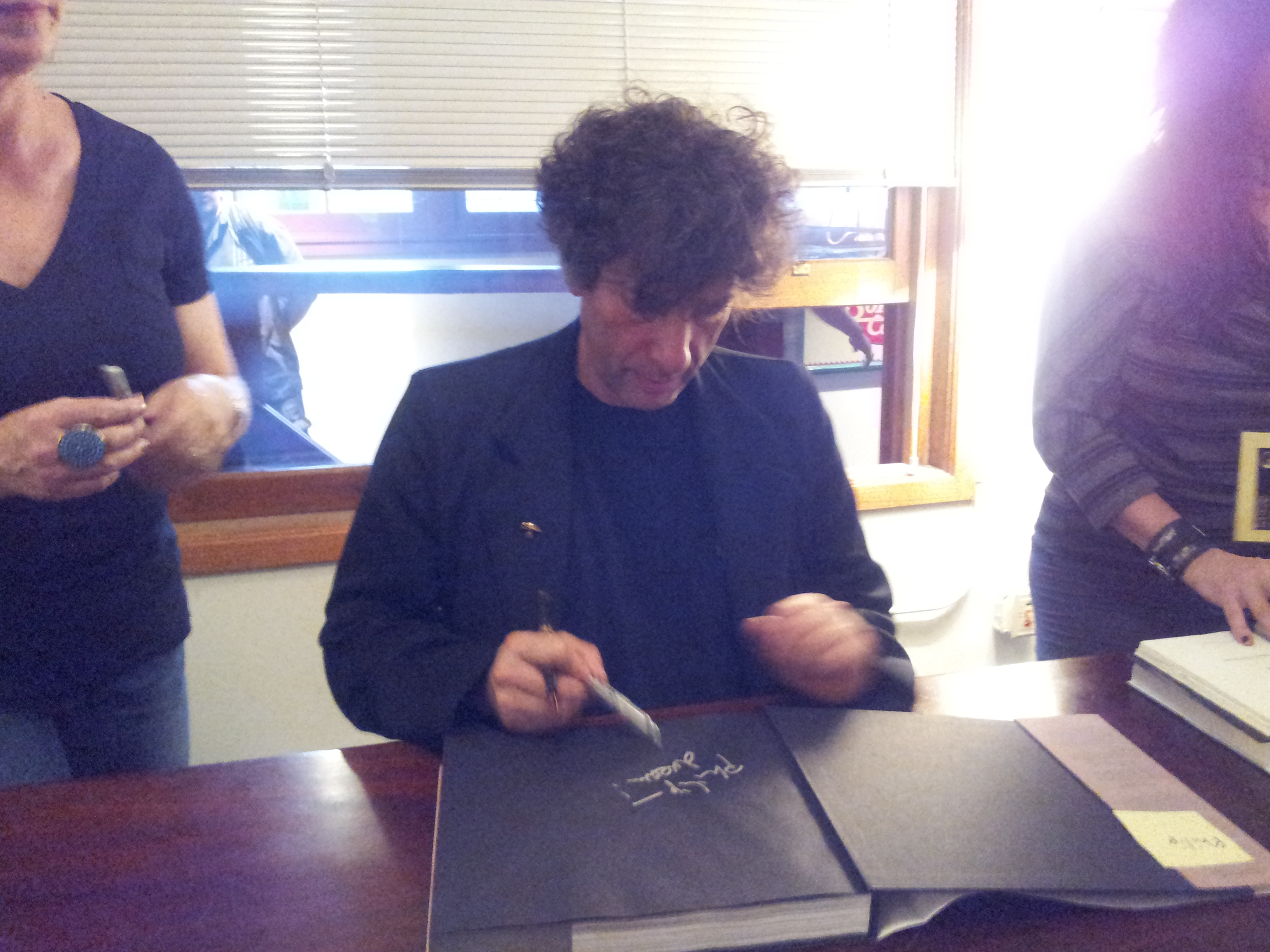
The remarkable Neil Gaiman in mid-signature.

The remarkable Neil Gaiman in mid-signature.

And finally, a close-up of the personalized signature.

And finally, a close-up of the personalized signature.

There is no way to accurately state how awesome this entire experience was. Mr. Gaiman was polite, professional, and incredibly enthusiastic to see all of us, despite the exhausting touring schedule. I, for one, cannot express my gratitude.

I woke up at five AM on Tuesday. This is something I would not normally do, as many of you know. As a general rule, the only time I see five AM is when I have stayed up all night. This was a happy exception, however. You see, Tuesday was Book Day.

Way back when I worked for Borders, I learned that new releases came out on Tuesdays. For whatever reason, your favorite author’s new book, that awesome band’s new CD, and that DVD you’ve been waiting for since you saw the film on opening night at the theatre all come out on Tuesdays. I would show up to my Tuesday morning shift to help with the unboxing and shelving of all of the latest titles that people had been asking for the for month prior. Despite the early hour, it was one of my most enjoyable shifts at that job. There was something wonderful about opening a box full of new books, knowing that in a few hours they would be in the hands of elated readers. Ever since then, there’s been a bit of a thrill surrounding Tuesdays for me, even though I’m not as connected to the retail world as I once was. Like I said, this was a special occasion. This Tuesday was the street date for Neil Gaiman’s The Ocean at the End of the Lane. 

I’m not entirely certain about how I first encountered Neil’s writing for the first time. At some point within the last seven years, though, I was introduced to the Sandman comics. I devoured them. Neil’s scripts and the absolutely gorgeous artwork drew me in, and within a month I’d read the entirety of his Sandman run. I wanted more, and I found it. Works like Coraline, American Gods, The Graveyard Book, and Neverwhere would be completed in days, if not hours after I started reading them. I told all of my friends that they needed to read his work. Any of it. All of it. To this day, I have not been disappointed by Neil Gaiman’s writing, whether it comes in graphic novels, children’s books, brilliant pieces of literature, or Doctor Who episodes. 

All of which brings me back to why I was awake at five AM on Tuesday. New Book Tuesday. The Ocean at the End of the Lane. There are lots of bookstores in Colorado Springs, but I didn’t want to buy my copy here in town, even though under any other circumstances I will shop locally first. I decided almost two months ago that I was going to be driving to Denver on June 18th so that I could buy a copy of Neil’s latest book from the Tattered Cover. This is because his upcoming book signing is going to be held at the Tattered Cover’s LoDo location, and purchase of the book from any one of their locations included a numbered ticket for the autograph line on the 25th. I’m number 53. I’d say that certainly merits being awake at five on my day off. There’s nothing quite like meeting other people who are willing to get up at a ridiculous hour in order to wait in line for a book. Many thanks to V for going on an adventure with me.

June is here, and I’ve been productive. I’m almost (finally) completely unpacked and pretty well set up in my new apartment. I’m sorting through books and paring down to no more than two copies of any given title, though some exception may be made for collectible editions (I’m looking at you, Tolkien).

Why two? I like to share my books with my friends, and it never hurts to have a backup of something you’re going to loan to somebody. Plus, it’s a good chance for me to use this:

Knock Knock's Personal Library Kit

Why, yes! I DID buy this for myself. How did you know?

Besides, I need to free up room in my place for new books. I’m very much looking forward to what I find next. Every day around books is a beautiful adventure.

Caution: Spoilers may lie ahead. You have been warned.

Back in the early 90’s, Mike Mignola began writing stories about a character named Hellboy, a demon pulled through to Earth during an occult ritual performed by a group of Nazis in 1944. Hellboy, then a child, was adopted by Professor Trevor Bruttenholm, founder of the Bureau for Paranormal Research and Defense (BPRD). Through the professor’s kindness, Hellboy became a champion for good, fighting against ghosts, demons, and eldritch abominations for years. Over time, Hellboy learned the truth of his origins and eventually sacrificed himself to save the world. (Hey, I warned you.)

That’s right, folks. Hellboy is dead, but that’s not about to slow him down. Late last year, Mignola announced that Hellboy would be back in a new ongoing series entitled Hellboy in Hell. 

Mike Mignola's Hellboy In Hell issue one cover

Exactly what it says on the tin.

Now I’ve read through the entirety of Hellboy and a good chunk of the spin-off series, BPRD, but I can’t wait to see how this one turns out. I love Mignola’s art and stories, and I’m thrilled to see one of my favorite comic book characters have new life in him, so to speak.

2013 is going to be the best year yet. I say that every year, but that’s because it’s true. Yeah, I’ve had fantastic experiences in the past, but each year that I’m still here, still reading and writing and doing what I love is an even better year than the one before.

What I’m looking forward to:

Books: Halo: Silentium  comes out this year, wrapping up Greg Bear’s Forerunner Saga, a sweeping epic prequel to the Halo franchise that ties in to last November’s Halo 4 release.

Dr. Sleep should hit store shelves this year as well, in late September according to Stephen King’s web page. Shining fans rejoice as we finally get to find out what happened to little Danny Torrance when he grew up.

Movies: Holy shit, have you seen the trailer for Pacific Rim? Guillermo Del Toro is back, and he’s bringing his incredible energy to what seems to be a bit of a love letter to giant Godzilla-esque monsters and massive robots built to take them down.

Iron Man 3 drops in May. I can’t wait to see Marvel’s first follow-up to The Avengers in a few months. Let’s see how Tony Stark handles dealing with one of his oldest comic book foes, The Mandarin.

We get to see J.J. Abrams’ follow-up to Star Trek with Star Trek Into Darkness. Best part about this? Benedict Cumberbatch gets to play a villain again. I can’t wait to see the crew of the Enterprise back in action.

Television: Arrested Development returns at last! Having a Netflix account would be worth it if only for this show. We’ll be seeing an entire season released exclusively via the streaming service sometime this year.

Game of Thrones is back this year as well, with the HBO adaptation of George. R. R. Martin’s epic fantasy series beginning a third season in March.

This is only the tip of the iceberg. It’s going to be a good year, dear readers. What books, movies, etc. are you looking forward to this year?

House of Leaves is an editor’s nightmare.

I love it. It’s a jumble of narratives, strange font choices and jarring shifts between them, footnotes that ramble on for several pages, and pages that suddenly switch direction as the labyrinthine house that serves as the main location for the book.

It is riddled with grammatical errors, and seems utterly nonsensical to anyone who picks the book up and flips through it, hoping to find some semblance of sanity within the pages. In short, it is everything that a novel about an eldritch abomination should be.

I recently finished reading the book, and I must say that while it was one of the most dense reads of all time, it was incredibly satisfying to be able to put the book down and know that it was complete. There’s nothing beyond the text whatsoever. There is nothing behind me, growling in my ears now that I’ve completed the book. 

In short, read the book if you’re looking for psychological horror. It’s not a quick read, but it will definitely make you think.